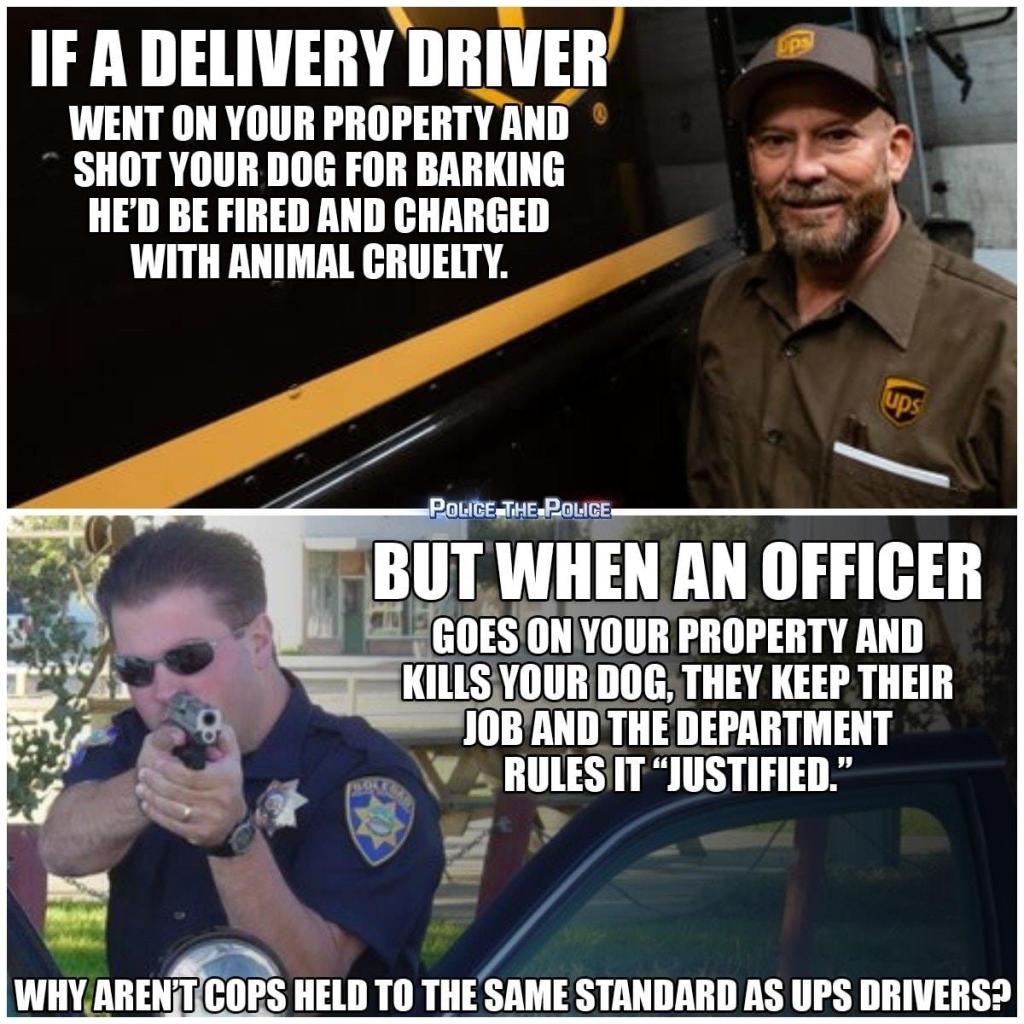
Cop Assaults, Cuffs Autistic Child, Kneels on His Neck, Pepper Sprays His Dog for Not Using a Leash

A 14-year-old boy with autism was left traumatized and physically injured last month after one of Topeka’s finest felt it necessary to throw him to the ground, handcuff him and then kneel on his neck in the same move that proved fatal for George Floyd — a fully grown man. The boy’s mother is now speaking out and seeking justice for her child.

According to police, they were responding to a call about the boy bringing his dog on a walk without a leash. There had been no incident — meaning the dog never once harmed anyone — but fear of an unleashed dog led to a police response.

“At around 4:26 p.m. the officer located the 14-year-old in the neighborhood a third time and conducted a pedestrian stop,” the police Facebook post said. “He did not comply with the officer’s commands. A use of force was generated when he was taken to the ground and handcuffed.”

The officer informed the boy that he was in violation of city law the first time and told him to take the “goddamn dog home” the second time, according to body-camera footage detailed in the audit report, and reported on by VICE.

The boy — who was likely scared to death when the armed man began yelling at him — did not immediately comply and decided to keep riding his bicycle home. When the officer finally caught up to the boy, violent force was used against him and his dog.

Keep reading

Unqualified Impunity: When Government Officials Break the Law, They Often Get Away With It

The horrifying video of George Floyd’s death, and the protests that followed, led to a rare occurrence: The police officers responsible are being prosecuted. Former Minneapolis police officer Derek Chauvin has been charged with murder and remains in jail, and three other officers are facing lesser charges.

Kentucky’s recent decision not to bring homicide charges against the officers who killed Breonna Taylor is much more typical. Most instances of law enforcement brutality do not result in criminal charges, even when they are captured on video. They often result in no consequences at all. This includes many cases of excessive force in response to the protests after Floyd’s death, but the problem is long standing, and not restricted to local police.

Border Patrol agent Jesus Mesa Jr. was not prosecuted or disciplined for shooting and killing a 15-year-old boy, and the Supreme Court ruled last year that the boy’s parents could not sue.

Most of the individuals responsible for the CIA torture program faced no consequences—in fact, one of the CIA employees who oversaw torture and evidence destruction now leads the agency.

And the list goes on.

Keep reading

Innocent Woman Didn’t Let Cops See Her Ring Video, So They Raided Her Home, Mocked Her

In January of this year, Monecia Smith was awakened in the middle of the night as a shirtless man pounded on her door seeking help. Moments later the man ran to her neighbor’s house before gunshots ran out. Monecia has a Ring camera system which did not capture the shooting but did capture part of the deadly encounter.

“I could see the muzzle (flash) of gunfire,” Smith, a mother of four, said to the Kansas City Star.

Smith said she showed the video to a family member of the victim, later identified as Derrick Smith, 31 (not related to Monecia), but when police showed up to her home and asked for it, she refused to hand it over — which is her constitutional right. Smith wasn’t committing a crime and explained that her decision to keep the video from police stems from her lack of trust in the department.

As the Star explains, Smith pointed to the questionable shooting deaths of Ryan StokesTerrance BridgesDonnie Sanders and others at the hands of Kansas City police officers, as the reason she does not trust them.

For all Smith knew, it was police who killed Derrick Smith and they could’ve been trying to seek out and destroy any evidence which showed it.

“There have been too many cases where nothing was done,” Monecia Smith said. “My trust for police has gone down the drain.”

Smith is not alone in her lack of trust for police. The Star interviewed 75 residents who share similar distrust.

“If people don’t trust the police, it is because a very severe injustice has occurred,” said Thomas C. O’Brien, a psychologist and postdoctoral researcher at the University of Illinois at Urbana-Champaign.

And, in Kansas City, severe injustice is seemingly routine.

Last week, TFTP reported on 25-year-old Deja Stallings — a nine-month pregnant woman who was body slammed and then knelt down on by cops for allegedly “hindering and interfering” while filming an arrest.

Before that, Karle Robinson, 61, was held at gunpoint and handcuffed at his home near Kansas City. His “crime”? Moving a TV into his new house — while black.

The list goes on and provides an impetus for today’s distrust that goes back decades. Proving Smith’s reason for distrust is the fact that she was raided by these cops the very next day after refusing to show them the video.

According to the report, Smith showed the video to a member of Derrick Smith’s family and when detectives found out about it, they requested a meeting inside her home. Smith politely declined.

“I didn’t feel safe with him in my house,” she said.

Smith had no idea how profoundly predictive that statement would be. The very next day, a militarized unit of cops in tactical gear kicked in Smith’s door and ransacked her apartment — making sure to denigrate her along the way.

Smith, who was at work during the raid on her home, was alerted by a neighbor and came over immediately. When she showed up, cops were still in her home and she was told she couldn’t enter. But her cameras inside were rolling.

“Go out and make sure these detectives are OK, ‘cause this bitch, (inaudible) she’s getting crazy,” one of the shock troops can be heard saying on the video.

“They did all of that for a DVR?” Smith said. “Why did I deserve that?”

The fact of the matter is that she didn’t deserve that at all. Smith later filed a grievance over the incident which was sustained by the Office of Community Complaints, a civilian agency tasked with holding the police accountable. Unfortunately, however, the agency is largely impotent and have very few tools to actually hold cops accountable.

Keep reading

D.A.R.E. Officer Dies of Overdose While Raiding Evidence Locker and Gets a Parade the Next Day

In June of this year, a police officer with over two decades on the job was found dead in the Winnemucca Police Department’s evidence locker. He had a bag of fentanyl in his pocket, yet when his death was announced, it was reported that officer Matt Morgan died of “natural causes.” The very next day, dozens of police departments from around the area put together a procession parade two hours long in his honor as people stood along the route to pay their respects. But Morgan didn’t die of natural causes and he had no business being in the department’s evidence locker that day.

“A procession honored Winnemucca Police Department Detective and community hero Matt Morgan, 47, who passed away unexpectedly while at work on Thursday, June 25, 2020, of apparent natural causes,” the report read after Morgan passed away.

But his death was not natural. Weeks later, an investigation would reveal that Morgan overdosed on fentanyl and methamphetamine in that evidence locker. What’s more, Morgan was not supposed to be in the locker that day and the investigation revealed that the evidence (seized drugs) had been tampered with by this “hero cop.”

According to the Humboldt County Sheriff’s Office, who is conducting the investigation, it is still ongoing.

Keep reading

Cops Mistake Innocent Man for a Suspect, Publicly Execute Him

Stagger’s story was buried in the media and written off after police claimed that he shot at them. CPD spokesman Anthony Guglielmi initially said officers had returned fire after a suspect shot at them. However, it would later be revealed that cops made that up and Curtis never fired any gun.

It would then take months to get any transparency in the case. Although Curtis was murdered in May, the body camera video was not released publicly until many months later.

According to police, they initially believed Stagger was wanted in connection with the shooting death of 15-year-old Jaylin Ellzey. But he was not. Nevertheless, a heavily militarized police SWAT team descended on the neighborhood. Whether or not they had the right person was apparently of no consequence to the officers.

When police officers found Stagger in his vehicle, they quickly surrounded him and opened fire through the window, killing him. Stagger never even tried to run.

Keep reading

Police killings more likely in agencies that get military gear, data shows

Hardware designed for war exerts subtle pressure on police culture, experts say.

Americans have seen it time and again in recent months on the nightly news: Protesters in the streets confronted by local police officers carrying assault rifles, some atop armored vehicles, looking more like soldiers than public servants.

Much of that equipment has trickled down to police departments from a controversial Defense Department initiative known as the 1033 program, a 30-year-old federal initiative that provides a way for the military to dispose of surplus equipment by sending it to local police.

The impact on policing has been huge. In Georgia alone, police departments and sheriff’s offices have received more than 2,700 military rifles, night vision goggles and laser gun sights, and literally hundreds of armored vehicles, including more than two dozen mine-resistant vehicles built to fight the war on terror abroad.

To get the military equipment, police departments pay only for the shipping costs. But that does not mean the program comes without other costs.

Keep reading

High Ranking Lt. and 5 Cops Keep Jobs After Admitted Involvement in Teen Sex Trafficking Case

An abused little girl was only 12-years-old when she was forced into the sex trade, forever altering the course of her life. For years, this little girl was “exploited by pimps” until she finally broke away and made it to an Oakland police officer. For a brief moment, she thought she was safe — but, according to a lawsuit, she was wrong and the cops began trafficking her. And all of it stems from police being entirely unable to hold problem cops accountable—even when there is evidence of sexual misconduct and a paper trail of sexting.

This week, we find out that a high-ranking Richmond police official and five other officers who exchanged explicit messages with the teen were all given written reprimands — and kept their jobs!

Keep reading