Massachusetts Marijuana Retailer Encourages Package Recycling With Discounted $4 Joint Offer

One of the state’s cannabis retailers is encouraging customers to recycle the plastic that encases certain cannabis products by offering them a $4 pre-rolled joint for every piece of packaging they return.

In the heavily regulated cannabis industry, nearly every product is required to come in child-resistant packaging that is typically made of plastic. Most of that plastic is not recyclable and ends up in the trash or tossed on the ground.

“Living in the city of Boston, I saw these [pre-roll] tubes all over the streets, they’re everywhere,” said Ture Turnbull, who with Wes Ritchie owns Tree House Craft Cannabis dispensaries in Pepperell and Dracut. “So we looked at what needed to be done, what the industry was doing to address this, what the policies around this were, and what opportunity there was for us to do right.”

Tree House’s recycling program incentivizes consumers to bring back their used packaging to the dispensary. Specifically, customers can return the plastic pop-top tubes that hold pre-rolled joints and the square-lidded containers that hold marijuana flower. For each piece of packaging customers return, they can buy a pre-rolled joint for $4—a price that yields savings ranging from $4 to $8 depending on what joint is on offer.

The brand of the pre-roll currently being offered is the company’s own Yellow Brick Road. Since May, when Tree House started the program, customers have returned more than 6,000 pieces of packaging and the company has offered an equivalent number of $4 pre-rolls.

“We literally had to put our money where our mouth is to create this incentive program because it has a monetary hit to us, but a benefit to the consumer, and that’s the only way we could actually see it taking off, to incentivize it,” said Turnbull. “This is the first try at a serious program that says: Let’s take the plastic and recycle it. Let’s take this environmental concern seriously.”

Tree House uses the recycled packaging in two ways. If the packaging is intact, it’s reused to package new products. If not, the company commissions artwork for its dispensaries that incorporates the plastic.

Keep reading

Which Countries Pollute The Most Ocean Plastic Waste?

Millions of metric tons of plastic are produced worldwide every year. While half of this plastic waste is recycled, incinerated, or discarded into landfills, a significant portion of what remains eventually ends up in our oceans.

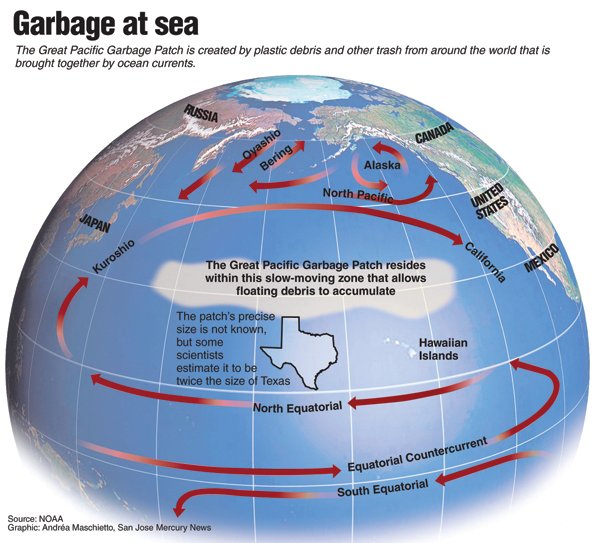
In fact, many pieces of ocean plastic waste have come together to create a vortex of plastic waste thrice the size of France in the Pacific Ocean between California and Hawaii.

Where does all of this plastic come from? In this graphic, Visual Capitalist’s Freny Fernandes and Louis Lugas Wicaksono used data from a research paper by Lourens J.J. Meijer and team to highlight the top 10 countries emitting plastic pollutants in the waters surrounding them.

Keep reading

Recycle THIS! Greenpeace admits plastic should just be thrown away

The green agenda across America has taken a huge hit, with a report confirming that Greenpeace is admitting that recycling plastic as “largely failed.”

The City-Journal cited the environmental organization’s recent report that was headlined, warningly, “Plastic Recycling Is A Dead-End Street – Year After Year, Plastic Recycling Declines Even as Plastic Waste Increases.”

The Greenpeace article found: “Mechanical and chemical recycling of plastic waste has largely failed and will always fail because plastic waste is: (1) extremely difficult to collect, (2) virtually impossible to sort for recycling, (3) environmentally harmful to reprocess, (4) often made of and contaminated by toxic materials, and (5) not economical to recycle.”

“This has been obvious for decades to anyone who crunched the numbers, but the fantasy of recycling plastic proved irresistible to generations of environmentalists and politicians. They preached it to children, mandated it for adults, and bludgeoned municipalities and virtue-signaling corporations into wasting vast sums—probably hundreds of billions of dollars worldwide—on an enterprise that has been harmful to the environment as well as to humanity,” the City-Journal reported.

Keep reading

Microplastics found in human blood for first time in ‘extremely concerning’ study

The world’s first study to look for the presence of plastics in human blood detected particles in 77 per cent of those tested, new research has found.

PET plastic, most commonly used to produce drinks bottles, food packaging and clothes, was the most prevalent form of plastic in the human bloodstream.

The authors said plastic particles can enter the body from the air as well as through food and drink.

Dick Vethaak, professor of ecotoxicology and water quality and health at the Vrije Universiteit Amsterdam in the Netherlands, told The Independent the findings were “certainly alarming because it shows that people apparently ingest or inhale so much plastic that it can be found in the bloodstream”.

“Such particles can cause chronic inflammation,” he added.

Keep reading