Javier Milei’s Free Market Reforms Are Starting To Pay Off

Argentina’s poverty rate fell sharply in the second half of 2024, according to official data released this week, marking a major milestone for President Javier Milei’s sweeping economic reforms.

According to the country’s official statistics agency, the National Institute of Statistics and Census (INDEC), the poverty rate fell to 38.1 percent between July 2024 and December 2024—down nearly 15 percentage points from the first half of the year. Household poverty also declined by 13.9 percentage points, hitting 28.6 percent. And extreme poverty was cut by more than half, falling from 18.1 percent to 8.2 percent.

It’s a major turnaround from the beginning of Milei’s presidency. When he took office in December 2023, he inherited a poverty rate of 41.7 percent, which quickly surged to 53 percent as his administration launched a “shock therapy” program to end Argentina’s economic misery.

One of the biggest drivers behind the poverty decline is the sharp drop in inflation. Annual inflation, which reached 276.2 percent a year ago—one of the highest in the world—dropped to 66.9 percent last month. Monthly inflation has also dropped, from 25.5 percent in December to just 2.4 percent in March.

“These figures reflect the failure of past policies, which plunged millions of Argentines into precarious conditions while promoting the idea of helping the poor, even as poverty continued to increase,” Milei’s office said in a statement following the release of the INDEC report. “The current administration has shown that the path of economic freedom and fiscal responsibility is the way to reduce poverty in the long term.”

In other words, Milei’s bet on free market reforms is starting to pay off. 

It’s worth remembering the situation he walked into. “Milei inherited a country suffering from more than 200% inflation in 2023, 40% poverty, a fiscal and quasi-fiscal deficit of 15% of GDP, a huge and growing public debt, a bankrupt central bank, and a shrinking economy,” writes Ian Vásquez of the Cato Institute.

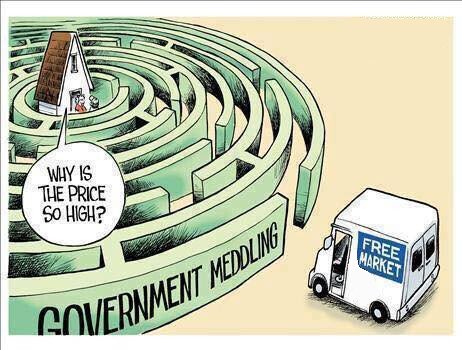
In response, Milei promised a radical shift in Argentina’s economic model. His government slashed government spending, eliminated price controls, devalued the peso, cut subsidies, suspended public works, and laid off thousands of government workers. The changes weren’t popular, but they were necessary. And now, the numbers are catching up.

The economy is growing again. Gross domestic product grew in the last two quarters. The gap between the black-market dollar and the official rate has narrowed. Rents have fallen and the housing supply has increased since rent control laws were scrapped. Meanwhile, investor interest in Argentina is beginning to return, and the International Monetary Fund (IMF) is in talks with Milei’s government over a new program. The IMF projects a 5 percent growth for Argentina in 2025. 

Still, challenges remain. Despite the improvement, over 11 million Argentines are still living in poverty, with 2.5 million facing extreme poverty. And more than half of all children ages 14 and under in Argentina are poor. 

Keep reading

Stakeholder Capitalism and the Corporate KPI Cult

In private business “[t]here is no need to limit the discretion of subordinates by any rules or regulations other than that underlying all business activities, namely, to render their operations profitable.”—Ludwig von Mises, Bureaucracy, p. 46

In this quote from his classic 1944 book Bureaucracy, Mises explains why private, for-profit businesses need not, and should not, be bureaucratic and entangled in rules and regulations mandated from the top of an administrative hierarchy. Instead, they should, make the best use of decentralized “knowledge of time and place” to do their jobs. Mises’ admonition that the focus of capitalist enterprises is and should be to “make a profit” later became, in the hands of Chicago School economists, “maximize shareholder value.” This view is most widely associated with Milton Friedman and was accepted by American corporate management, for the most part, for many years.

Then in 2018 Blackrock CEO Larry Fink, who managed $6 trillion in corporate assets at the time, publicly insisted that corporate executives should focus on “stakeholders” (i.e., virtually everyone connected in any way with a corporation) instead of shareholders. This was followed in August of 2019 by 200 CEOs of major corporations issuing a declaration that maximizing shareholder value was no longer their paramount goal; adding value to all “stakeholders” was.

At the time, George Reisman wrote on the Mises Wire that this showed that “many CEOs know so little about economics that they don’t know that in a free market producing for the profit of their stockholders in and of itself implies producing for the benefit of everyone.” A successful, profitable business in a free competitive market will have customers who have benefited more than they have spent; workers will be paid more than they can make elsewhere; there will be prosperous towns and cities; and it benefits all “stakeholders” generally.

What is so significant about the CEO declaration, wrote Reisman, is that “it shows to what extent America’s intellectual heritage of the right to pursue happiness (which includes the pursuit of profits) has rotted away and been replaced by a mentality ripe for socialism” (emphasis added). He then says that we must keep in mind that “as the arbitrary power of the state has grown, businessmen have been put in a position more and more resembling that of hostages held by terrorists.”

Keep reading

Why Equality Is Bad

Many people oppose the free market because it leads to inequality of wealth and income. It is unfair, they say, that some people have vastly more money than others. Some defenders of the free market respond that these inequalities, while undesirable in themselves, make the poor better off than they would be otherwise, and so should be accepted. Another argument made by defenders of the free market is that restricting inequality would interfere liberty, so that, although inequality is bad, we have to put up with it.

While it is true that inequality makes the poor better off and that restricting inequality interferes with liberty, these are not the best arguments that defenders of the free market should use. They accept that inequality is bad, but we should reject this assumption. There is nothing bad about inequality.

People are unequal in every dimension of their being, including weight, height, muscle build, intelligence, and so on. This just the way the world is. Why should we try to change it? People who attempt this have a grudge against the world. They are not satisfied with the way God created it.

And of course they can’t succeed. As the great Murray Rothbard points out, absolute equality is impossible. No two places on earth, for example, offer precisely the same view.

If we shouldn’t defend the free market by arguing that it decreases equality, what should we do? Fortunately, there are many better arguments available. I’m going to list a number of them, but if you want more details, you should read Murray Rothbard’s Power and Market and Ludwig von Mises’s Human Action.

One of the best of these arguments is that the free market makes possible mutually beneficial gains from trade. If I have something that you want and you have something I want, we can make an exchange, so we are both better off. But what if our exchange makes someone else worse off? This question is a version of the “externalities” or “market failure” argument. The claim is that some of our activities, including trade, impose costs on others. If so, this indicates a failure to define property rights. Once we do so, the so-called “problem” dissolves.

Keep reading

Unmasking the Forgotten Villain: How Robert Doughton’s Secretive Anti-Liberty Agenda Still Haunts America and North Carolina Today

Few politicians have had as lasting and detrimental an impact on U.S. governance as Robert L. Doughton. 

Serving in Congress for over four decades (1911–1953), Doughton helped shape some of the most sweeping expansions of federal power in U.S. history. 

His policies, ranging from supporting high taxes to advocating for massive entitlement programs, left a legacy that prioritized government control over individual liberty. 

Despite being celebrated for his role in projects like the Blue Ridge Parkway, Doughton’s broader impact on personal freedoms and economic freedom casts a long, dark shadow. In examining his career, it becomes clear that Doughton was one of the most damaging figures to the principles of limited government and free markets in U.S. and North Carolina history.

Keep reading

Wealth Mobility vs. Feudal Caste System

In a free market economy, anyone with determination could “get rich.” It is what gave rise to The American Dream (e.g., a house, a white picket fence, 2.5 kids, and a loyal dog). This is different from the feudal societies of the past, when only certain people could ever get rich. Feudalism is a type of cronyism, feudal lords gave fealty to a king.

If the king wanted local persons “shaken down” (or shaken up), then the noble, lord, or baron would pay those common people a “visit” and he would remind them who is in charge. In return for putting fear into the hearts of the local people, the king granted noble estates. By being loyal hooligans, feudal barons were guaranteed land and riches.

But feudalism is the opposite of a free market economy. There is wealth mobility in free market economies (anyone can get rich), but wealth stability in feudalism — only cronies can ever get rich. A sign of feudalism shows up in the ratio of riches (wealth) to income. Under feudalism, held wealth dwarfs any earned income, such as wages.

Keep reading

Law and State Coercion: The Liberating Effects of Free Markets

Many who support state regulation of free markets claim that they are not against free markets, just against unregulated free markets. They argue that regulation is needed to mitigate the harm that may be suffered during market participation, such as people working long hours for low wages or suffering racial discrimination. As Ronald Hamowy explains in his introduction to Friedrich von Hayek’s “The Constitution of Liberty,” these arguments were influential in the rise of both welfare socialism and national socialism:

“It was generally thought that only through vigorous government intervention was it possible to forestall the more destructive aspects of unbridled capitalism, which, if left unchecked, would bring privation and misery to the great mass of people. Equally important, only government direction could galvanize and coordinate the productive facilities of a nation so as to minimize waste and maximize wealth creation.”

The premise that free markets require some form of regulation, so that the debate only concerns how much regulation is needed, strikes many people as superficially reasonable: This premise seems to call merely for moderation, balance, mitigation of harm and the absence of excess. This is usually seen as the basic role of law and regulation. Walter Williams explains that “people have always sought to use laws to accomplish what they cannot accomplish through voluntary, peaceable exchange” in the belief that if free markets do not yield their preferred outcomes, they can achieve those outcomes through law and regulation.

Politicians of all stripes uphold this premise, debating only what types of interventions are required and which should take priority. There is widespread consensus among social scientists on the need for a welfare state, with debate only concerning the precise form of welfare schemes. As Hamowy observes, many intellectuals gave Hayek’s “Constitution of Liberty” a frosty reception because it challenged their belief in the importance of the welfare state and market regulation: “Intellectuals in both Europe and the United States appear to have remained wedded to the view that an extensive welfare state was necessary to insure economic stability and the public’s social welfare and that any defense of free markets bordered on the crackpot, unworthy of comment.”

In the field of labor market regulation, interventions are not limited to protecting workers from privation and misery. Regulations may also be designed to protect vested interests, such as preventing entry into the market by participants who enjoy what is seen as an unfair competitive advantage, or designed for racial protectionism, to prevent demographic encroachment by other races.

Keep reading

Civilization Depends Upon Economic Freedom

The BBC recently slapped a “trigger warning” on its popular 1969 series Civilisation, warning that viewers may deem the series objectionable as it presents Eurocentric perspectives. The series is now deemed to be “problematic” because it tells a “European story,” focusing on the Renaissance and the Enlightenment. This is criticized by academics—for example, the classicist Mary Beard—for excluding other cultures and also for excluding women while showcasing the achievements of men in Greece, Rome, France, Italy, Germany, and Britain.

This rejection of Eurocentricity by modern academics pervades the “decolonize” movement that has swept through all scholarly disciplines across the humanities and natural sciences. The science of economics has not been spared. Economic theories that have long been associated with economic progress and civilization are also rejected. The concept of “civilization” itself is rejected on the grounds that all cultures are equal; therefore, all cultures are a form of civilization, and no civilization is superior to any other. In this worldview, there is no particular reason why economic freedom should be prioritized above any other social goal.Jeffries, DonaldBest Price: $15.55Buy New $14.00(as of 11:47 UTC – Details)

Economic freedom concerns the human liberty to engage in the activities necessary to sustain prosperity and civilization, as well as the institutional conditions necessary for human beings to thrive. Economic liberty is therefore subsumed within civilization itself. The two concepts are linked, and the idea that we can choose to reject economic principles while maintaining the level of economic progress to which we have become accustomed is simply wrong. Ludwig von Mises explains this in Human Action:

What is wrong with our age is precisely the widespread ignorance of the role which these policies of economic freedom played in the technical evolution of the last two hundred years. People fell prey to the fallacy that the improvement of the methods of production was contemporaneous with the policy of laissez faire only by accident.

Keep reading