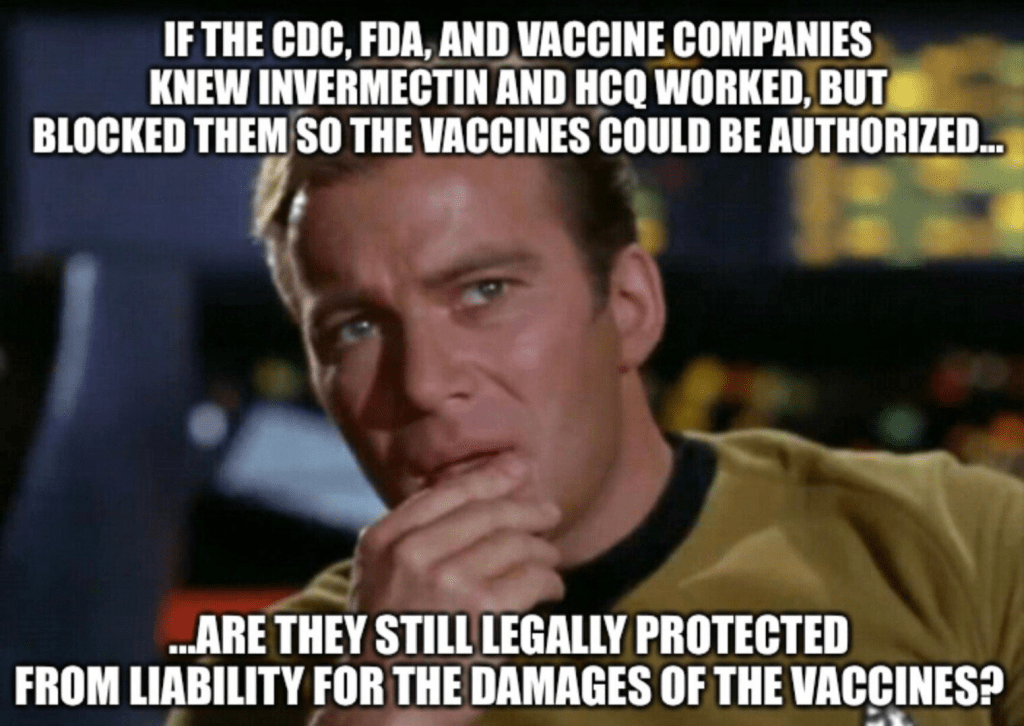
A good question, Captain…

A publicly available FDA “fact sheet” document reveals that 86% of children who participated in a Pfizer covid vaccine trial reported adverse reactions ranging from “mild” to “serious.”
As part of the vaccine experiments, children aged 12 to 15 are being injected with mRNA sequences that take control of their cells, causing them to churn our spike proteins in their blood. Spike proteins cause vascular disease and blood clots. Even the Jonas Salk Institute conclusively identifies spike proteins as the culprit behind vascular disease and blood clots.
This is all openly admitted by the FDA, which has published extremely disturbing reports of adverse reactions experienced by children in a Pfizer covid vaccine “fact sheet” labeled 144413. See the original FDA document here (PDF).
In case the FDA removes this sheet, we have archived it at Natural News servers here (PDF).
Many Americans who have chosen not to get one of the experimental COVID-19 vaccines because of the risks have hoped that testing positive for antibodies could substitute for being vaccinated, providing a virtual “vaccine passport.”
But the Food and Drug Administration issued guidance this week stating a vaccine is still needed to confirm immunity from the COVID-19 virus.
The FDA acknowledged that antibody tests “can play an important role in identifying individuals who may have been exposed to the SARS-CoV-2 virus and may have developed an adaptive immune response.”
“However, antibody tests should not be used at this time to determine immunity or protection against COVID-19 at any time, and especially after a person has received a COVID-19 vaccination.”
The FDA said that antibodies provided by the vaccines are superior to the antibodies developed from being infected by the virus, providing needed protection that the regular antibodies do not.
But that’s contradicted by empirical study data, Yale University epidemiologist Dr. Harvey Risch told WND.
He pointed to a massive study in Israel finding that people who had tested positive for the novel coronavirus in the previous three or more months had at least as much protection against new infection, hospitalization and death as vaccinated people.
“People become immune by surviving infection,” argued Risch, professor of epidemiology in the Department of Epidemiology and Public Health at the Yale School of Public Health and Yale School of Medicine.
The FDA’s Peter Marks admitted that that 40-50 percent of CDC and FDA employees have opted not to take the vaccine during an exchange with Sen. Richard Burr.
NIAID Director Anthony Fauci said the number is about the same for his agency.

Federal inspectors identified a series of problems at the Baltimore facility where the ingredients for up to 15 million doses of Johnson & Johnson vaccine were ruined, according to a Food and Drug Administration report obtained by NBC News.
The report, known as FDA Form 483, says the plant operated by Emergent BioSolutions “is not maintained in a clean and sanitary condition.” Inspectors found peeling paint and unidentified black and brown residue on the floors and walls, as well as a failure to properly decontaminate waste generated during the manufacture of the vaccine drug substance.
Last week, legal accountability group Judicial Watch dropped a bombshell: a nearly 600-page report proving the U.S. government has been buying and trafficking “fresh” aborted baby body parts. These body parts, purchased by the U.S. Food and Drug Administration to “humanize” mice and test biologic drugs in scientific experiments, came from babies up to 24-weeks-old gestation, just weeks from being born.
While Americans may be used to hearing pro-lifers beat the warning drum on abortion groups harvesting baby bodies and selling them for research, (who hasn’t heard of the lawsuit against David Daleiden, who exposed Planned Parenthood haggling over baby lungs and livers at dinner parties?) this time, the U.S. government was the one trafficking baby parts.
Recent emails uncovered by Judicial Watch between FDA employees and the California-based Advanced Bioscience Resources (ABR) prove the agency spent tens of thousands of dollars buying aborted babies for unethical scientific experiments between 2012 and 2018. In 2018, the Trump administration terminated the contract, halting government fetal tissue research due to concerns the contracts were unlawful. Judicial Watch’s new FOIA Request adds 575 pages of recordsto its existing 2019 lawsuit against the agency.
 Hellbound and Down
You must be logged in to post a comment.