
Are you ready for this week’s absurdity? Here’s our weekly roll-up of the most ridiculous stories from around the world that are threats to your liberty, risks to your prosperity… and on occasion, inspiring poetic justice.
Tag: face masks
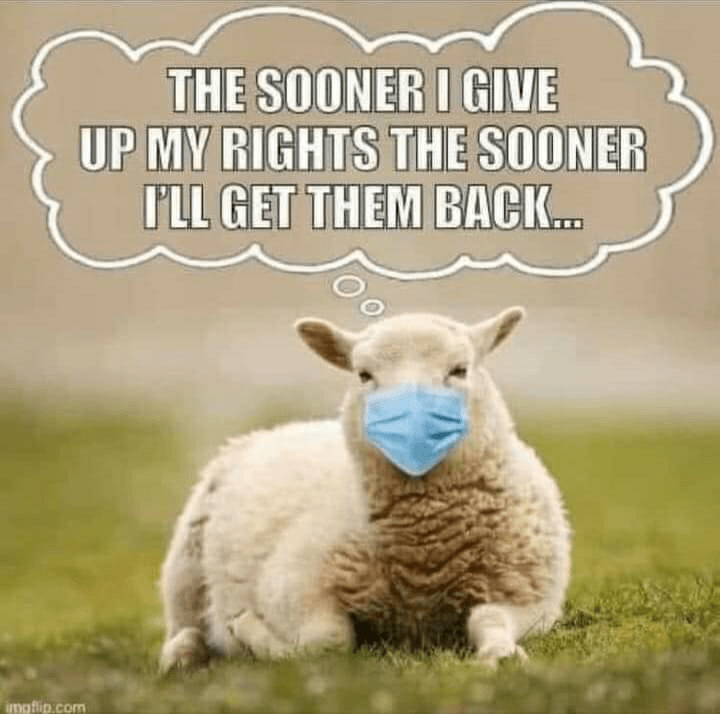
Sheeple logic…
‘I’m The Public Face’: Here’s A List Of Lawmakers Who Broke COVID Rules
- Not all lawmakers have been willing to follow social distancing restrictions during the coronavirus pandemic.
- Democratic Philadelphia Mayor Jim Kenney was photographed dining indoors Sunday, though Philadelphia still prohibits indoor dining.
- Democratic Chicago Mayor Lori Lightfoot and Democratic House Speaker Nancy Pelosi attended hair appointments despite COVID restrictions.
- Here’s a list of lawmakers who have tried to dodge coronavirus rules.
Lawmakers have mandated a variety of COVID restrictions to stem the spread of the pandemic, but not all lawmakers have been willing to follow the rules.
Governors, mayors and state health departments have required that Americans wear masks, social distance, refrain from spending time in large groups, quarantine after traveling across state lines, stay home from church services and much more.
But many political leaders and members of their families have failed to comply with social distancing rules. Here’s a list of lawmakers who appeared to dodge coronavirus-related restrictions.
Perception…

Sound fair?

Mission creep…
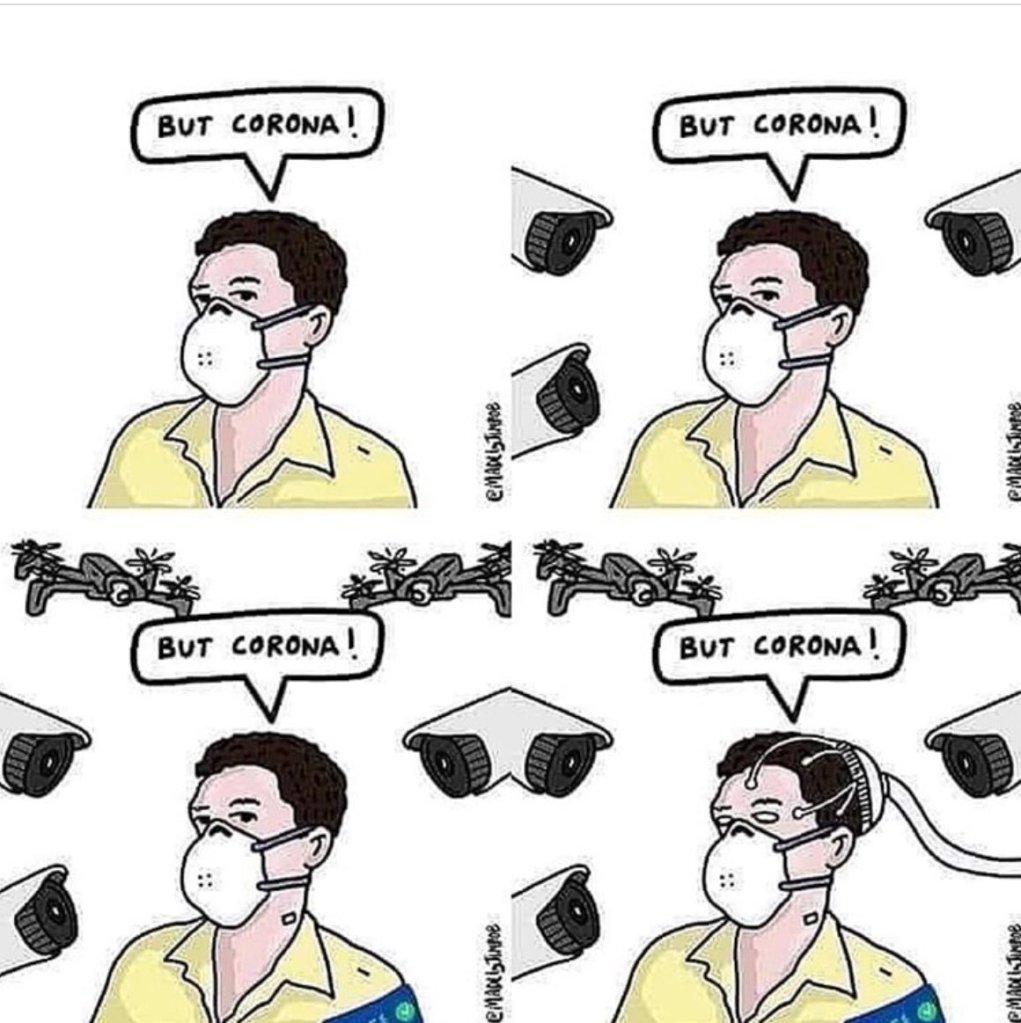
Wear it proudly?

Off-duty Cop and Friends Assault Restaurant Owner, Smash Desk After Being Asked to Mask Up
Surveillance video from inside Ming Dynasty showed an off-duty Quincy police officer and three other people become violent and go crazy when a dispute arose over wearing a face mask.
The video shows a 49-year-old woman smashing the front desk of the restaurant over the mask dispute, while attacking the owner.
“She was pushing my husband and smashed my front desk,” restaurant owner Lei Yan said. “It put my husband’s life in danger.”
Accompanying the woman was the off duty cop who also became irate and was using his badge to justify his illegal actions.
Yan said the group came in after midnight and was very drunk. She said the incident started after the restaurant refused to serve them drinks.
“When they came in, they looked very drunk,” Yan stated.
After being refused drinks, the group of drunks then allegedly left their seats to protest Yan’s decision and refused to put on masks.
That’s when the violence started and when the cop protected the offender.
“He just took his police ID, showing our whole bar, our whole restaurant,” restaurant co-owner Jimmy Tian said. “Like, I’m a police officer, I don’t need a mask.”
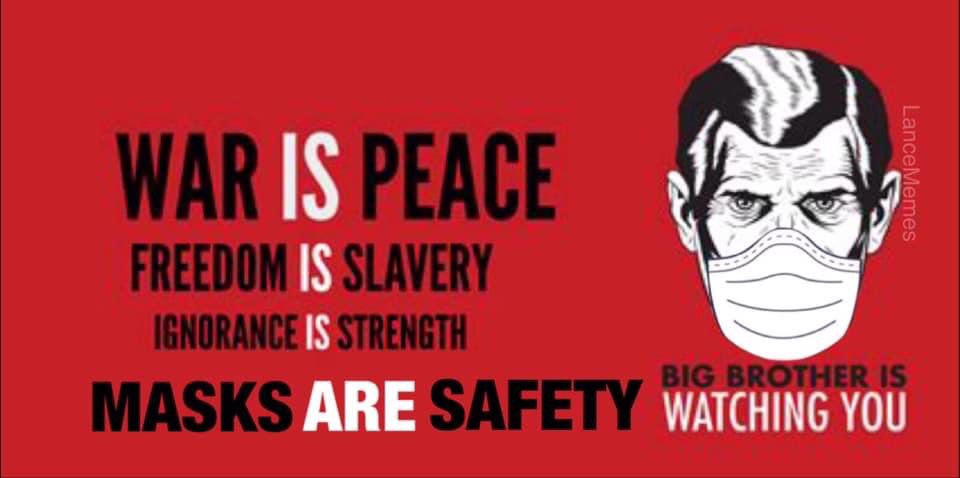
Masks are safety…
Face masks make you stupid
Face masks can now be added to the list of mandates that make you stupid. As if Piers Morgan feverishly promoting them weren’t evidence enough, here are the facts on why you absolutely, categorically should not wear a face mask. They make you suggestible; they make you more likely to follow someone else’s direction and do things you wouldn’t otherwise do. In short, they switch off your executive function – your conscience.
A great example comes from a study by Mathes and Guest (1976), who asked participants how willing they would be, and how much they would have to be paid, to carry a sign around the university cafeteria reading “masturbation is fun” (this being 1976, doing such a thing would be considered embarrassing; these days it will probably earn you a course credit!). The results showed that when people wore a mask, they were more likely to carry the sign and required less money to do so ($30 compared to $48, on average).
Meanwhile, Miller and Rowold (1979) presented Halloween trick-or-treaters with a bowl of chocolates and told them they were allowed to take only two each. When the children thought they weren’t being watched, they helped themselves. Children without a mask broke the rule, taking more chocolates, 37% of the time, compared to 62% for masked children. The authors concluded that masks “lead to lower restraints on behaviour”.
The effect has similarly been found online: the online disinhibition effect refers to the tendency for people to act antisocially when anonymous online (Suler, 2004). There is even an infamous trolling movement calling itself Anonymous and using a mask as its symbol.
The disinhibiting effects of wearing a mask are described by psychologists in terms of a suspension of the superego’s control mechanisms, allowing subconscious impulses to take over. Saigre (1989) wrote that masks ‘short-cut’ conscious defence systems and encourage “massive regression” to a more primitive state; Castle (1986) wrote that eighteenth century masquerades allowed mask-wearers to release their repressed hedonistic and sexual impulses; and Caillois (1962) similarly wrote about European masked carnivals involving libidinal activities including “indecencies, jostling, provocative laughter, exposed breasts, mimicking buffoonery, a permanent incitement to riot, feasting and excessive talk, noise and movement”. In the 12th Century, Pope Innocent III banned masks as part of his fight against immorality; and in 1845, New York State made it illegal for more than two people to wear masks in public, after farmers wore masks to attack their landlords.
From a neuroimaging perspective, masks are known to inhibit identity and impulse control – both associated with executive function in the prefrontal cortex (e.g., Glannon, 2005; Tacikowski, Berger & Ehrsson, 2017). In other words, masks silence the Jiminy Cricket in the brain.
It is little wonder that covering our mouths would ‘shut us up’ psychologically. Studies have shown that clothing has a powerful effect on how we think (or not), via a principal known as enclothed cognition: wearing a lab coat enhances cognitive function (Adam & Galinsky, 2012), wearing a nurse’s scrubs increases empathy (López-Pérez et al., 2016), and wearing counterfeit brands increases the likelihood of cheating in a test (Gino, Norton & Ariely, 2010). Similarly, in the world of body language, someone putting their hand over their mouth is a sign that they are listening intently: they are ready to receive information, not to question it.
While no studies have looked at the effect of masks on verbal reasoning, it is fairly safe to assume that priming a ‘shutting up’ would have a cognitive effect. For example, extraverts are less compliant than introverts (Cohen et al., 2004; Gudjonsson et al., 2004); the development of conscience in humans is heavily linked to that of language (e.g., Arbib, 2006); and inner speech is highly related to cognitive functions (Alderson-Day & Fernyhough, 2015). Crucially, verbal reasoning is strongly correlated with moral reasoning (e.g., Hayes, Gifford & Hayes, 1998): being unable to ‘speak’ makes one less able to deduce what is moral and immoral behaviour.
There is also a more basic reason masks might make you stupid: decreasing oxygen flow to the brain. Face veils reduce ventilatory function in the long-term (Alghadir, Aly & Zafar, 2012), and surgical masks may reduce blood oxygenation among surgeons (Beder et al., 2008): believe it or not, covering your mouth makes it harder to breathe. Reviewing the N95 face mask, a 2010 study (Roberge et al.) concluded that “carbon dioxide and oxygen levels were significantly above and below, respectively, the ambient workplace standards” inside the mask. A post-COVID study found that 81% of 128 previously-fit healthcare workers developed headaches as a result of wearing personal protective equipment (Ong et al., 2020).
Not only do face masks make it hard to breathe, but the evidence that they even work to stop the spread of coronavirus is limited at best. A popular brand of mask even carries a warning on its packaging that it “will not provide any protection against COVID-19”; as for preventing carriers from spreading the disease, a meta-analysis found, for example, that of eight randomised control trial studies, six found no difference in transmission rates between control and intervention groups (while one found that a combination of masks and handwashing is more effective than education alone, and the other found that N95 masks are more effective than standard surgical masks; bin-Reza et al., 2012). Non-surgical masks, such as scarfs and cloths, are almost useless (Rengasamy et al., 2010). Masks may even be unhealthy, causing a build-up of bacteria around the face (Zhiqing et al., 2018).
The fact that masks likely don’t even work brings us to the final reason that wearing one inculcates stupidity and compliance: through a bombardment of lies, contradictions, and confusion, the state overwhelms your ability to reason clearly.
 Hellbound and Down
You must be logged in to post a comment.