
Things are so bad in Los Angeles County that health officials are now advising all essential workers to wear masks inside their own home to prevent spreading Covid-19 within their household.”Right now, because there is so much spread, we’re recommending that people wear their face coverings while they’re inside the home,” Los Angeles County Director of Public Health Barbara Ferrer said in a news conference Monday. That’s for people who are either leaving their home every day for work or who are running errands regularly for their family, Ferrer said.Doing so, she said, “will add a layer of protection while we get through this surge.”
Tag: face masks
Didn’t mean to do that…

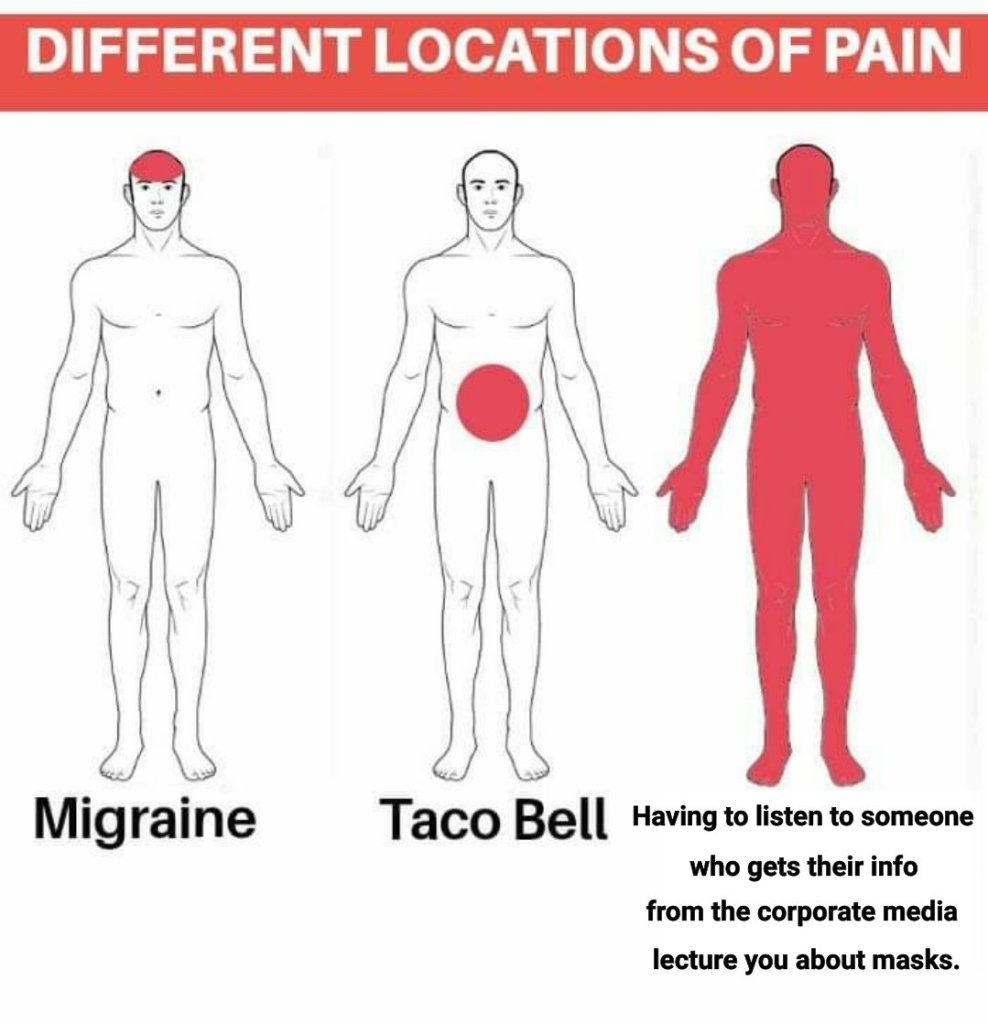
Tell me where it hurts…
If masks work…
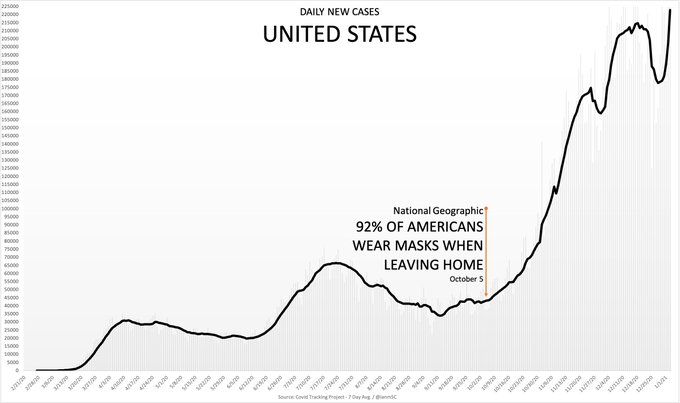
A question…

Disabled child removed by police from AMC theater for failing to wear a mask
A video recorded in Jacksonville, N.C. appears to show the manager of an AMC movie theater refusing to allow a reportedly disabled child from entering the theater without a mask, and calling the police to escort her distraught family from the scene.
The child, who was in a stroller at the time of the incident, is reportedly non-verbal and has a condition that precludes her use of a mask or face shield. The child’s family members were all wearing masks.
Police officers were ultimately asked to escort the upset family from the theater.
The Jacksonville, N.C. Police Department and the AMC Theatres chain did not immediately respond to requests for comment.
Public health policy surrounding the use of masks on toddlers and children has become a subject of controversy over the last several months. Throughout the pandemic, there have been countless stories of families being thrown off flights or having flights canceled altogether because a baby was failing to don the required facial covering.
More than 1.5 billion masks believed to have entered oceans in 2020
For months, we’ve seen face masks in places they shouldn’t be: storm drains, streets, beaches, and parks.
Now, we’re learning just how many could be flooding our oceans.
“Once plastic enters the marine environment, it’s very difficult to move,” said Dr. Teale Phelps Bondaroff, director of research for OceansAsia.
The marine conservation group has been tracking the number of face masks washing up on a remote island south of Hong Kong since the pandemic started.
“About six weeks after COVID hit Hong Kong, so late February, we began finding masks, and lots of masks,” said Bondaroff. “What’s remarkable is we weren’t finding face masks before COVID.”
Masks are made with polypropylene, which Bondaroff describes as thin fibers of plastic.
“The fact that we are starting to find masks that are breaking up indicates that this is a real problem, that microplastics are being produced by masks,” he said.
These tiny pieces of plastic can remain in the ocean for hundreds of years, threatening fish and even polluting the air.
“The question that we couldn’t answer was how many are entering our oceans? We just didn’t know,” said Dr. Bondaroff.
OceansAsia launched a study to find the answer and recently shared its findings.
Of the estimated 52 billion masks manufactured globally in 2020, it’s believed 1.56 billion will enter our oceans this year, resulting in an additional 4,680 to 6,240 metric tonnes of marine plastic pollution
About that mask…

Mask Mandates Seem to Make CCP Virus Infection Rates Climb, Study Says
Protective-mask mandates aimed at combating the spread of the CCP virus that causes the disease COVID-19 appear to promote its spread, according to a report from RationalGround.com, a clearinghouse of COVID-19 data trends that’s run by a grassroots group of data analysts, computer scientists, and actuaries.
Researchers examined cases covering a 229-day period running from May 1 through Dec. 15 and compared the days in which state governments had imposed mask mandates and the days when they hadn’t.
In states with a mandate in effect, there were 9,605,256 confirmed COVID-19 cases, which works out to an average of 27 cases per 100,000 people per day. When states didn’t have a statewide order—including states that never had mandates, coupled with the period of time masking states didn’t have the mandate in place—there were 5,781,716 cases, averaging 17 cases per 100,000 people per day.
In other words, protective-mask mandates have a poor track record so far in fighting the coronavirus. States with mandates in place produced an average of 10 more reported infections per 100,000 people per day than states without mandates.
You say potato…


You must be logged in to post a comment.