Moar Power: White House Considers Invoking “Unprecedented” Climate Emergency

How best to grab power when there’s no convenient emergency to use as excuse? Invent one!

That’s right: if you had ‘climate emergency’ on your ‘list of disasters to prompt mail-in balloting’ bingo card, you may soon be able to cross that square off. That’s because the Biden administration is reportedly renewing discussions “about potentially declaring a national climate emergency,” according to Bloomberg

Such an “unprecedented” declaration could “unlock federal powers to stifle oil development”, among other things, the report says. 

Bloomberg reports, according to sources who requested anonymity as a final decision has not been reached, top advisers to President Joe Biden are reconsidering the possibility of declaring the emergency.

This action could lead to restrictions on crude exports, a suspension of offshore drilling, and a reduction in greenhouse gas emissions, sources say.

Within the White House, opinions are split on this issue. Some advisers believe that declaring a climate emergency wouldn’t grant Biden sufficient new powers to enact significant changes. Others, however, contend that it could energize voters who prioritize climate issues.

Keep reading

Officials Along Path of Eclipse Quietly Declaring States of Emergency

They have good reasons for doing it. And we have good reasons for not trusting them.

Sometimes, two seemingly contradictory statements each contain essential truths.

Last week, Republican Gov. Eric Holcomb, of Indiana, signed Executive Order 24-05, a statewide disaster emergency declaration in advance of Monday’s expected total solar eclipse.

Parts of Indiana lay in the eclipse’s path of totality. For that reason, Holcomb predicted “several hundred thousand visitors” to the state.

If that happens, then the massive influx of people “may well stress and/or interfere with first responder and public safety communications and emergency response systems such that a technological or other emergency may occur,” Holcomb’s order read.

Fortunately, according to WLS, Indiana’s membership in the Emergency Management Assistance Compact allows it to call on other member states for resources.

Indiana has not seen a total solar eclipse since 1869 and will not see another until 2099.

Thus, officials in The Hoosier State and elsewhere have begun preparations for a once-in-a-lifetime event.

Chairman Shaun Gilliant, of the Essex County New York Board of Supervisors, for instance, explained that he and other county officials declared a state of emergency in anticipation of heavy traffic and even cellular service disruptions, according to NBC 5 in New York.

According to WHIO in Dayton, Ohio, the city council in nearby Riverside will decide at Thursday night’s meeting whether to declare a temporary emergency.

Keep reading

Statewide Emergency Declared in Indiana Ahead of Solar Eclipse

Indiana Gov. Eric Holcomb issued a statewide emergency due to a large influx of visitors to his state to view the total solar eclipse on April 8.

The Republican official said that the number of visitors to Indiana may strain the state’s communications, transportation, and emergency response systems, warranting the need for the declaration. Indiana includes some of the best locations in the United States to see the eclipse, according to a map of the path of totality.

“The massive number of people viewing this event in our state may well stress and/or interfere with first responder and public safety communications and emergency response systems such that a technological or other emergency may occur,” Mr. Holcomb said in a statement last week, adding that the declaration was issued as a precaution to bring in emergency resources from other states.

His order noted that the eclipse “will pass directly over the state of Indiana, giving everyone in our state an incredible view of this extremely rare event.” The order stated that the last time a total solar eclipse passed over the state was in 1869. After the event on April 8, the next one is not expected to occur for about another 75 years.

“It is of primary importance to the state of Indiana to be prepared to protect the health, safety and welfare of the public during this event and to be prepared to swiftly and effectively respond to any emergency that may arise,” the order continued.

The state’s capital and largest city, Indianapolis, is located in the eclipse’s path of totality, local media reported.

Keep reading

WHO’s proposed IHR amendments and Pandemic Treaty will create perverse incentives to declare pandemics

The World Health Organisation (“WHO”) will present two new texts for adoption by its governing body, the World Health Assembly, in Geneva on 27 May – 1 June.

The new Pandemic Treaty needs a two-thirds majority for approval and, if and once adopted, will come into effect after 40 ratifications. The amendments to the International Health Regulations (“IHR”) can be adopted by a simple majority and will be binding on all states unless they recorded reservations by the end of last year.

Note: WHO’s Pandemic Treaty is also referred to as the Pandemic Accord and WHO Convention Agreement + (“WHO CA+”).

WHO describes the IHR as “an instrument of international law that is legally binding” on its 196 states parties, including the 194 WHO member states, even if they voted against it. Therein lies its promise and its threat.

The new regime will change WHO from a technical advisory organisation into a supranational public health authority exercising quasi-legislative and executive powers over states; change the nature of the relationship between citizens, business enterprises, and governments domestically, and also between governments and other governments and WHO internationally; and shift the locus of medical practice from the doctor-patient consultation in the clinic to public health bureaucrats in capital cities and WHO headquarters in Geneva and its six regional offices.

From net zero to mass immigration and identity politics, the “expertocracy” elite is in alliance with the global technocratic elite against majority national sentiment. The Covid years gave the elites a valuable lesson in how to exercise effective social control and they mean to apply it across all contentious issues.   The changes to global health governance architecture must be understood in this light. It represents the transformation of the national security, administrative, and surveillance state into a globalised biosecurity state.

The IHR amendments will expand the situations that constitute a public health emergency, grant WHO additional emergency powers and extend state duties to build “core capacities” of surveillance to detect, assess, notify and report events that could constitute an emergency.

The existing language of “should” is replaced in many places by the imperative “shall,” of non-binding recommendations with countries will “undertake to follow” the guidance. And “full respect for the dignity, human rights and fundamental freedoms of persons” will be changed to principles of “equity” and “inclusivity” with different requirements for rich and poor countries, bleeding financial resources and pharmaceutical products from industrialised to developing countries.

With a funding model where 87 per cent of the budget comes from voluntary contributions from rich countries and private donors like the Gates Foundation, and 77 per cent is for activities specified by them, WHO has effectively become a system of global public health patronage.

Human Rights Watch says the process has been “disproportionately guided by corporate demands and the policy positions of high-income governments seeking to protect the power of private actors in health including the pharmaceutical industry.”

The victims of this Catch-22 lack of accountability will be the peoples of the world.

Keep reading

‘Emergency’ Spending Is Out of Control

Emergencies are, by definition, unexpected and urgent situations requiring immediate action—except in Congress, where the term is increasingly used to justify spending decisions that should be part of the normal budget process.

Congress has authorized more than $12 trillion in emergency spending over the past three decades, according to a report released in January by the Cato Institute. About half of that total was spent in direct response to the Great Recession and the COVID-19 pandemic, but much of the other half was used for purposes that strain the definition of emergency.

Keep reading

Congress Wastes Billions With Bogus Emergency Declaration

What constitutes an emergency? According to Congress’ new spending package, research equipment and facilities for the National Science Foundation is an emergency. So are the 2024 Democratic National Committee convention and the Republican National Committee convention. So is NASA space exploration. 

By classifying all these line items as emergencies, Congress can get hundreds of millions of taxpayer funding for them with reduced oversight.

Congress’ latest spending package, released this week, is hardly the first time obviously nonemergency projects have been given this special funding designation. According to a January report from the Cato Institute, Congress has approved over $12 trillion in spending for emergencies over the past three decades, making up around 1 in 10 federal budget dollars spent—more than both Medicaid and veterans programs combined.

How is this possible? Much of it comes down to lax rules that let lawmakers classify regular spending projects as “emergencies.” 

“Congress has complete discretion in designating spending for emergencies because what qualifies as an emergency is subject to interpretation,” Romina Boccia and Dominik Lett wrote in Cato’s report. While the Office of Management and Budget (OMB) has laid out several criteria that emergency spending is supposed to meet, Boccia and Lett note that “the current process lacks a mechanism to evaluate whether an emergency provision meets the OMB’s test, which means that anything can count as emergency spending.”

Once spending gets earmarked as an emergency, it isn’t subjected to typical caps on discretionary spending, allowing Congress to rack up costs with little accountability. “Unfortunately, over the course of the last 30-some years, Congress took what was designed to be a ‘break glass in case of emergency’ escape valve, and they’ve turned it into a major source of funding for federal activity,” David Ditch, a senior policy analyst at The Heritage Foundation, tells Reason.”It’s just a way for [Congress] to avoid fiscal consequences. And that’s part of how we got where we are.”

“Emergencies are, by definition, unexpected and urgent situations requiring immediate action—except in Congress, where the term is increasingly used to justify spending decisions that should be part of the normal budget process,” Eric Boehm pointed out in the April 2024 issue of Reason magazine, “Because emergency spending bypasses some of the scrutiny applied to the normal budgetary process, it has become a convenient way for lawmakers and presidents to hike spending—and add to the national debt.”

Cato’s report highlights some particularly egregious examples of this exact phenomenon, including $600 million earmarked for replacing aircraft used in weather forecasting, $347 million for prison construction and detention costs, and $278 million to speed up the building process for a single research center.

Keep reading

The U.N. Is Planning To Seize Global ‘Emergency’ Powers With Biden’s Support

In September 2024, less than two months before the next U.S. presidential election, the United Nations will host a landmark “Summit of the Future,” where member nations will adopt a Pact for the Future. The agreement will solidify numerous policy reforms offered by the U.N. over the past two years as part of its sweeping Our Common Agenda platform.

Although there are numerous radical proposals included in the agenda, perhaps none are more important than the U.N. plan for a new “emergency platform,” a stunning proposal to give the U.N. significant powers in the event of future “global shocks,” such as another worldwide pandemic.

Many of the details of the U.N. emergency platform were laid out in a March 2023 policy paper titled “Strengthening the International Response to Complex Global Shocks — An Emergency Platform.” In the paper, the U.N. secretary-general writes, “I propose that the General Assembly provide the Secretary-General and the United Nations system with a standing authority to convene and operationalize automatically an Emergency Platform in the event of a future complex global shock of sufficient scale, severity and reach.”

Once triggered, the emergency platform would give the U.N. the ability to “actively promote and drive an international response that places the principles of equity and solidarity at the centre of its work.” The U.N. would bring together the “stakeholders” of the world, including academics, governments, private sector actors, and “international financial institutions” to ensure there is a unified, global response to the crisis.

The emergency platform would also give the United Nations the power to “Ensure that all participating actors make commitments that can contribute meaningfully to the response and that they are held to account for delivery on those commitments.”

In other words, the United Nations would be given unprecedented authority over the public and private sectors of huge swaths of the world, all in the name of battling a yet unknown crisis.

Keep reading

Rule by Decree: The Emergency State’s Plot to Override the Constitution

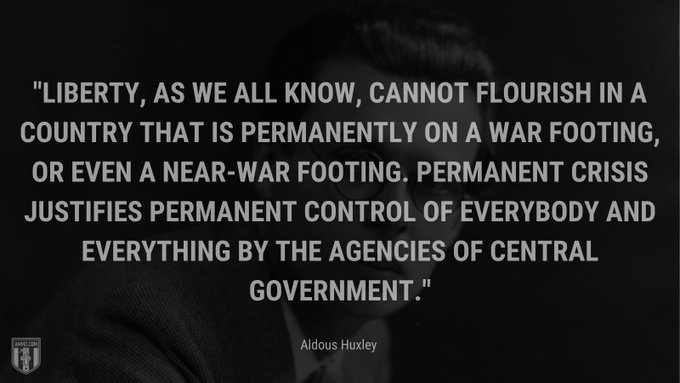
We have become a nation in a permanent state of emergency.

Power-hungry and lawless, the government has weaponized one national crisis after another in order to expand its powers and justify all manner of government tyranny in the so-called name of national security.

COVID-19, for example, served as the driving force behind what Supreme Court Justice Neil Gorsuch characterized as “the greatest intrusions on civil liberties in the peacetime history of this country.”

In a statement attached to the Supreme Court’s ruling in Arizona v. Mayorkas, a case that challenged whether the government could continue to use it pandemic powers even after declaring the public health emergency over, Gorsuch provided a catalog of the many ways in which the government used COVID-19 to massively overreach its authority and suppress civil liberties:

Executive officials across the country issued emergency decrees on a breathtaking scale. Governors and local leaders imposed lockdown orders forcing people to remain in their homes. They shuttered businesses and schools, public and private. They closed churches even as they allowed casinos and other favored businesses to carry on. They threatened violators not just with civil penalties but with criminal sanctions too. They surveilled church parking lots, recorded license plates, and issued notices warning that attendance at even outdoor services satisfying all state social-distancing and hygiene requirements could amount to criminal conduct. They divided cities and neighborhoods into color-coded zones, forced individuals to fight for their freedoms in court on emergency timetables, and then changed their color-coded schemes when defeat in court seemed imminent.

“Federal executive officials entered the act too.  Not just with emergency immigration decrees. They deployed a public-health agency to regulate landlord-tenant relations nationwide. They used a workplace-safety agency to issue a vaccination mandate for most working Americans.  They threatened to fire noncompliant employees, and warned that service members who refused to vaccinate might face dishonorable discharge and confinement.  Along the way, it seems federal officials may have pressured social-media companies to suppress information about pandemic policies with which they disagreed.

“While executive officials issued new emergency decrees at a furious pace, state legislatures and Congress—the bodies normally responsible for adopting our laws—too often fell silent.  Courts bound to protect our liberties addressed a few—but hardly all—of the intrusions upon them. In some cases, like this one, courts even allowed themselves to be used to perpetuate emergency public-health decrees for collateral purposes, itself a form of emergency-lawmaking-by-litigation.”

Yet while the government’s (federal and state) handling of the COVID-19 pandemic delivered a knockout blow to our civil liberties, empowering the police state to flex its powers by way of a bevy of lockdowns, mandates, restrictions, contact tracing programs, heightened surveillance, censorship, overcriminalization, etc., it was merely one crisis in a long series of crises that the government has shamelessly exploited in order to justify its power grabs and acclimate the citizenry to a state of martial law disguised as emergency powers.

Keep reading