
Droning on…

To summarize the company’s manifesto. It said: “See Spot KILL!! Spot is an empathy-building tool, because: Cute and approachable!”
Here’s the manifesto:
See Spot Run. It tops out at a blistering 3mph.
See Spot Roll Over. Spot is an empathy missile, shaped like man’s best friend and targeted straight at our fight or flight instinct. When killer robots come to America they will be wrapped in fur, carrying a ball. Spot is Rob Rhinehart’s ideal pet: it never shits.
Good Boy, Spot! Everyone in this world takes one look at cute little Spot and knows: this thing will definitely be used by police and the military to murder people. And what do police departments have? Strong unions! Spot is employee of the month. You never need to union bust a robot – but a robot can union bust you.
The manifesto continued, “Boston Dynamics and they HATED this idea.” They said the robotics company even offered them two free robots to call off the event.
See Spot KILL!! Spot is an empathy building tool, because: Cute and approachable! We talked with Boston Dynamics and they HATED this idea. They said they would give us another TWO Spots for FREE if we took the gun off. That just made us want to do this even more and if our Spot stops working just know they have a backdoor override built into each and every one of these little robots.
See Spot Fall Over And Freak Out. Quite an experience to live in fear, isn’t it? That’s what it is to be a slave. Our saving grace: Spot is evil but not very good at its job.
Boston Dynamics wasn’t thrilled with the stunt.
Loitering munitions, otherwise known as kamikaze drones, differ from other weapons in being relatively slow but able to patrol an area for a prolonged period looking for targets before identifying, selecting and attacking them.
The LRUSV is much smaller than the flagship Sea Hunter unmanned experimental vessel and the Navy’s Overlord robot transport but shares many of their goals. Like them, the LRUSV is supposed to travel the sea lanes without direct human supervision, sailing safely with other vessels. Unlike them it will “collaboratively interact with other vessels as a cluster,” suggesting that numbers of LRUSV would be deployed together. Such a cluster could unleash a swarm of dozens, hundreds or even thousands of small drones to overwhelm a target. (And while they might not be able to sink a warship, knocking out radar and defensive systems would leave it an easy target for other weapons).
Raytheon previously developed low-cost swarming drones based on their proven Coyote under the U.S. Navy’s LOCUST program in 2015. The goal was for a swarm which would work together collaboratively as a unit – and which would collectively cost less than a single missile. By 2016, 30 of the 13-pound drones were flying together, but the swarm size is likely to have increased significantly since.
As reported last month, a would-be assassin’s bullet struck but did not penetrate Trump’s bedroom window while he slept during the early morning hours on January 26. Bullet proof glass, which he had installed recently, probably saved his life. And ballistic experts who at first speculated that the shot originated from a chopper hovering off the coast have dismissed that hypothesis in favor of a more plausible premise—an armed drone.
A source in Trump’s orbit speaking under condition of anonymity has given Real Raw News more information on the shocking assassination attempt and subsequent investigation.
Trump’s investigation team, our source said, dismissed the gunman in a helicopter theory after obtaining radar logs from Palm Beach Intl. Airport and the US Coast Guard Station, Lake Worth Inlet. Neither radar had detected a helicopter within 15 miles of Mar-a-Lago between 3:00-4:00 that morning.
Although radar is an imperfect technology—and helicopters are small—most civilian and military radar systems employ a technology called Multilateration, a technique for figuring out a ‘vehicle’s’ position based on measurement of the times of arrival of energy waves having a known speed when propagating either from or to multiple system stations. In short, if a helicopter were there, radar would have detected it.
Trump, of course, did not deduce this on his own. To interpret the radar data, Trump hired USAF retired CMsgt. Anthony Vance, who for 12 years was a Radar Approach Control operator at Joint Base Andrews, which was then called Andrews Airforce Base. After retiring from the military, Vance was tower chief at JFK Intl. Airport, one of the busiest airports in the world. He has spent most of his life interpreting radar nuances.
“Vance studied the logs and said he was 99% certain that no helicopter was in the vicinity of Mar-a-Lago when the bullet hit the window. Trump believed him, but was still furious and wanted answers. Upon closer inspection of the radar logs, Vance saw something he thought might interest Trump,” our source said.
The logs revealed four surface contacts, or ships, within three miles of Mar-a-Lago at around the time of the attack.
A radar’s ability to detect and track surface contacts is dependent on several variables—sea and atmospheric conditions, the size of the vessel and, most important, whether the ship has a mast. The taller the mast, the greater the chance it will reflect a radar signal to the source.
“Vance figured out that the nearest contact was stationary about a half mile off the coast when the round hit the window. Within minutes, that contact headed due west and accelerated to 30knots. The only landmass west is the Bahamas, but the radar lost track after thirty miles. These discoveries made Trump’s people dump the helicopter theory and think about a drone having been launched from the ship.”
Trump enlisted the aid of a former General Atomics aeronautical engineer, Stephen Duckworth, to bolster the drone theory. Duckworth had extensive credentials and had played a pivotal role in the development of the US military’s MQ-1 Predator UMV.
Duckworth excluded commercially available drones as possible culprits, but he told Trump that a custom-built drone fitted with gyroscopic stabilizers and advanced night vision or thermal optics could have, theoretically, fired a weapon affixed to the chassis.
“You do know the CIA has this stuff?” Duckworth reportedly told Trump.
“That is a bulletin released to all law enforcement earlier this week, that there is, until the end of April, a persistent threat of domestic extremism, uh, domestic terrorism, carried out and the ideology and around this belief that the election, um, was fraudulent, that the Covid restrictions are unnecessary, all of those ideologies pushed by Donald Trump, ” Wallace said.
Wallace continued, “But my question for you is around incitement. Um, we had a policy, and it was very controversial, it was carried out under the Bush years and under the Obama years, of attacking terrorism at its root. Of going after and killing, and in the case of Anwar al-Awlaki an American, a Yemeni-American, with a drone strike for the crime of inciting violence, inciting terrorism.”
On January 20, in the minds of the establishment left, a new dawn was on the horizon with nothing but unicorns, a$15 minimum wage, and free health care and college for all. However, many on the left are already learning that their new messiah, Joseph R. Biden, is not that different from the right’s former messiah when it comes to wars, the police state, and immigration.
Though the right claims Biden is “going to open up the borders” so all the immigrants can rush in and “take our jobs and rape our children” that is not what will happen. For people outraged by Trump putting “kids in cages” as part of his crackdown on illegal immigration over the last four years, Joe Biden is not different, in fact when you read below to see what is unfolding, you will see that he is worse.
Remember, Biden was vice president during the Obama administration which aggressively deported more immigrants than Trump and who also put “kids in cages.” In fact, the photos used to first bring attention to kids in cages under Trump, were actually taken during Biden’s tenure as VP and the detention facilities were an Obama-era creation.
Sure, Biden used executive action to stop the construction of Trump’s silly wall that was easily scalable and could easily be circumvented. He also stopped new enrollments in the Migrant Protection Protocols program, which forced asylum seekers to wait in often-dangerous circumstances in Mexico for their US immigration hearings. However, this is little more than virtue signaling for which the media can have something to praise him. Behind the scenes, Biden and his advisers have something in the works that dwarfs Trump’s wall — a “virtual” or “smart” wall.
Biden’s new “Smart” wall will use advanced surveillance technology to patrol the border, presenting a danger to immigrants and citizens alike. According to a report in The Nation, while the full text of the immigration legislative proposal Biden sent to Congress has not been made public, a fact sheet distributed to reporters contains a section titled “Supplement existing border resources with technology and Infrastructure,” which calls for additional funding to, among other things, “enhance the ability to process asylum seekers” and “manage and secure the southern border between ports of entry that focuses on flexible solutions and technologies that expand the ability to detect illicit activity.”
The smart wall will not be as obvious and physically offensive as an actual wall, but aerial drones, infrared cameras, motion sensors, radar, facial recognition, and artificial intelligence is far more ominous than steel and bricks.
The day was supposed to be joyous. On December 12, 2013, the al Ameri and al Taisy families joined together in Yemen’s al Bayda province to celebrate the marriage of Abdullah Mabkhout al Ameri and his new wife Wardah al Taisy. During the traditional wedding procession from the bride’s home, a United States drone launched four missiles and killed 12 people. Seven members of the al Ameri family and five members of the al Taisy family were killed; six more were injured.
“Everyone here was shocked,” Ahmed Mohamed al Shafe’ee al Taisy, whose 25-year-old son was killed in the strike, said later in a witness statement. “Those drones don’t only fly, they kill people.”
Over the next five years, members of the al Ameri and al Taisy families, and their neighbors, were victims of six more attacks. The year 2017 was particularly brutal: they say that 15 members of their families were killed on January 29 after an on the ground raid, two distantly related neighbors died on March 6, one family member was killed on November 23, three died on November 26, and one died on December 22, during drone strikes. Less than a year later, on September 18, 2020, two more family members were killed. Over seven separate attacks by the United States—six drones strikes and one raid—36 members of the al Ameri and al Taisy families were killed. A quarter of them were children between the ages of three months and 14 years old. The families lost loved ones, homes, livestock, and neighbors, as 12 other people were killed by the strikes as well. Though U.S. government authorities have claimed throughout the years that the targets were terrorists, investigators and the families have consistently said that is untrue. While it has been seven years since the first strike, they still haven’t received any answers; instead, they live in fear.
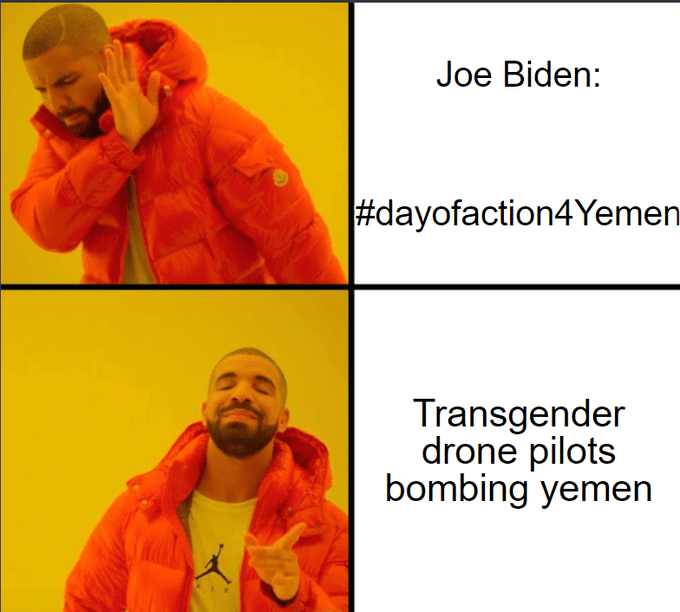
Trump’s base has been forcefully pushing the narrative that the previous president didn’t start any new wars, which while technically true ignores his murderous actions like vetoing the bill to save Yemen from US-backed genocide and actively blocking aid to its people, murdering untold tens of thousands of Venezuelans with starvation sanctions, rolling out many world-threatening cold war escalations against Russia, engaging in insane brinkmanship with Iran, greatly increasing the number of bombs dropped per day from the previous administration, killing record numbers of civilians, and reducing military accountability for those airstrikes. Trump may not have started any “new wars”, but he kept the old ones going and inflamed some of them. Just because you don’t start any new wars doesn’t mean you’re not a warmonger.
Rather than a throwback to “new wars” and the old-school ground invasions of the Bush era, the warmongering we’ll be seeing from the Biden administration is more likely to look like this. More starvation sanctions. More proxy conflicts. More cold war. More coups. More special ops. More drone strikes. More slow motion strangulation, less ham-fisted overt warfare.

 Hellbound and Down
You must be logged in to post a comment.