Depressed by the War on Drugs? Magic Mushrooms May Help.

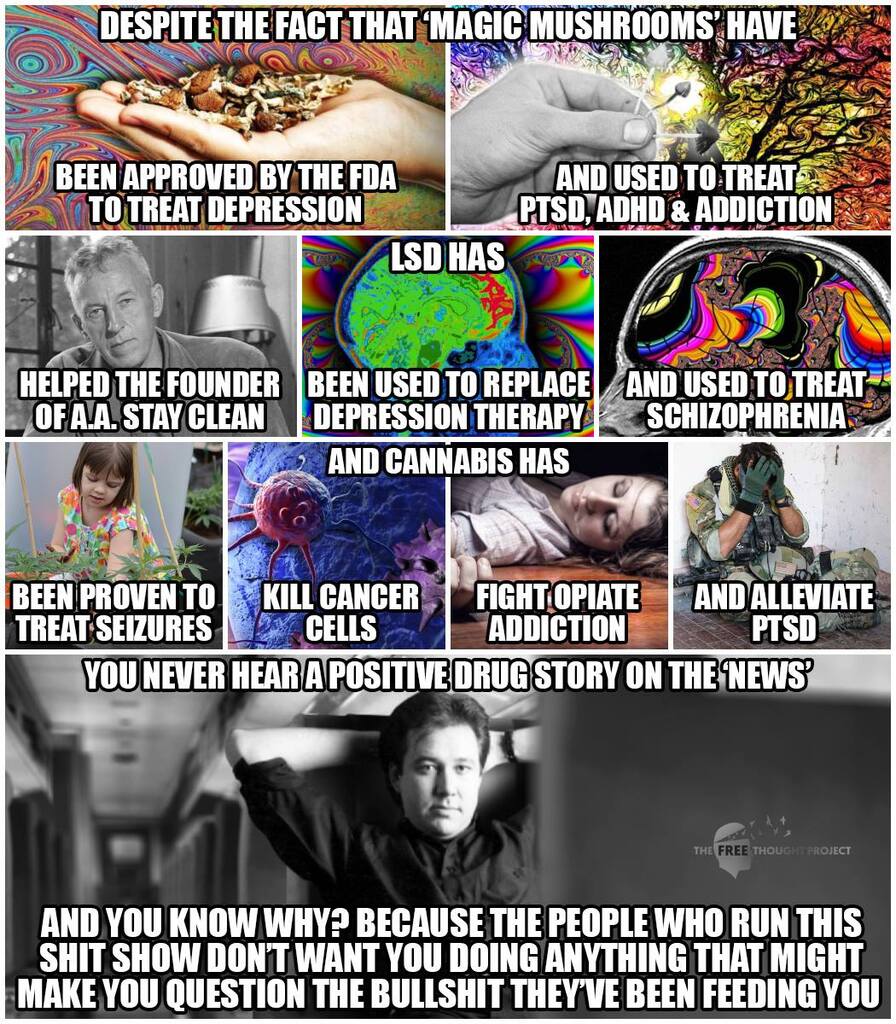
Hallucinogenic drugs like psilocybin-containing magic mushrooms are closely linked in the public imagination with hippies and pleasure-seeking. While there’s nothing inherently wrong with pleasure-seeking (we’ll see about hippies), growing evidence suggests that, properly used, these drugs may be just as effective for healing minds as they are at blowing them. A recently published study reports that, among other uses, psilocybin is a very effective treatment for depression.

“In a randomized, placebo-controlled, 6-week trial in 104 adults, a 25-mg dose of psilocybin administered with psychological support was associated with a rapid and sustained antidepressant effect, measured as change in depressive symptom scores, compared with active placebo,” according to the authors, led by Dr. Charles L. Raison of Wisconsin’s Usona Institute, of “Single-Dose Psilocybin Treatment for Major Depressive Disorder: A Randomized Clinical Trial,” published in August in the Journal of the American Medical Association. “No serious treatment-emergent adverse events occurred.”

The trial, conducted at different locations between December 2019 and June 2022, included participants between ages 21 and 65 who had been diagnosed with major depressive disorder of at least 60 days’ duration. Half of the participants were given a 25-mg dose of psilocybin and the other half were given niacin as a placebo, administered in identical capsules. The patients were assessed at eight days (the original end point of the study) and then at 43 days (the extended time frame).

Over the course of the study, “a single 25-mg dose of psilocybin administered with psychosocial support was associated with clinically and statistically significant reductions in depressive symptoms and improvement in measures of functional disability compared with a 100-mg dose of niacin placebo administered under an identical protocol.” The researchers also found a higher rate of sustained remission from depression symptoms among those who received psilocybin, “but the difference was not statistically significant.”

Adverse events potentially related to psilocybin consumption included one reported migraine, a headache, and one participant experiencing panic attack and paranoia. Nothing similar was found among the placebo group. As side effects go, that’s pretty mild and comparable to those linked to commonly used antidepressant drugs. Hence the finding that the study resulted in “no serious treatment-emergent adverse events.”
Keep reading

Psilocybin Associated With ‘Significantly’ Reduced Symptoms Of Major Depression After One Dose, American Medical Association Study Finds

People with major depression experienced “clinically significant sustained reduction” in their symptoms after just one dose of psilocybin, a new study published by the American Medical Association (AMA) found.

A team of 18 researchers from institutions including Yale University, Johns Hopkins University, NYU Langone Center for Psychedelic Medicine and San Francisco Veterans Affairs Medical Center investigated the association, carrying out a randomized clinical trial involving 104 adults with major depressive disorder (MDD).

For the study, published in the Journal of the American Medical Association (JAMA) on Thursday, people with major depressive disorder were administered 25mg of synthetic psilocybin at 11 different clinics across the U.S. and monitored for changes in symptoms over the course of six weeks.

Within eight days, patients who received the psychedelic-assisted treatment, which was also accompanied by psychotherapy sessions, reported reduced depressive symptoms that “maintained across the 6-week follow-up period, without attenuation of the effect.”

Keep reading

Psychedelic drug improves symptoms of depression for six months, finds study

psychedelic drug that gives trips lasting half an hour improves the symptoms of moderate to severe depression for up to six months, early trial results suggest.

Biotechnology company Small Pharma announced the results of its phase 2a clinical trials of the effects of a pharmaceutical-grade formulation of Dimethyltryptamine (SPL026) on major depressive disorder, simply referred to as depression.

The drug is a powerful hallucinogenic found in several plants and is the psychoactive compound found in ayahuasca, a compound used in shamanic rituals in South America.

In the study, 34 patients were given the drug during a clinical session with supportive therapy.

The individual sessions lasted less than two-and-a-half hours, and included a preparation session with a therapist, a psychedelic experience after administering the drug (where the therapist was present) lasting less than 30 minutes, and a therapy session to help patients process their trip.

Keep reading

Have millions been taking antidepressants with harmful side-effects for decades – when there’s no scientific evidence they do what they claim? Some experts have suspected it for years. Now patients have been left reeling by a groundbreaking study

Like millions of patients who seek help from their GPs for depression, Emma Ward was repeatedly told she was suffering from ‘an imbalance of chemicals in the brain’.

If Emma wanted to get better, her doctors said the 26-year-old should keep taking the antidepressants she had been prescribed since she was 15 — even though the drugs did not seem to improve her mood, and left her feeling perpetually numb emotionally.

Now, shocking new research published yesterday shows that the theory justifying the millions of prescriptions for antidepressants handed out every month to patients such as Emma, is simply not true.

The research confirms what some medical professionals have increasingly come to suspect. That the ‘chemical imbalance’ theory — that depression is due to a lack of the brain chemical serotonin — is nothing more than a myth.

This myth was created more than 35 years ago by pharmaceutical companies to justify their products, and has been perpetuated ever since by the training and practice of doctors around the world. In the most comprehensive review of the research on links between depression and serotonin ever carried out, researchers from the UK, Italy and Switzerland looked at 17 major international reviews that had documented the findings from more than 260 studies, involving 300,000 patients.

Keep reading

Psychedelics: How They Act On The Brain To Relieve Depression

Up to 30% of people with depression don’t respond to treatment with antidepressants. This may be down to differences in biology between patients and the fact that it often takes a long time to respond to the drugs – with some people giving up after a while. So there is an urgent need to expand the repertoire of drugs available to people with depression.

In recent years, attention has turned to psychedelics such as psilocybin, the active compound in “magic mushrooms”. Despite a number of clinical trials showing that psilocybin can rapidly treat depression, including for cancer-related anxiety and depression, little is known about how psilocybin actually works to relieve depression in the brain.

Now two recent studies, published in The New England Journal of Medicine and Nature Medicine, have shed some light on this mysterious process.

Psilocybin is a hallucinogen that changes the brain’s response to a chemical called serotonin. When broken down by the liver (into “psilocin”), it causes an altered state of consciousness and perception in users.

Previous studies, using functional MRI (fMRI) brain scanning, have shown that psilocybin seems to reduce activity in the medial prefrontal cortex, an area of the brain that helps regulate a number of cognitive functions, including attention, inhibitory control, habits and memory. The compound also decreases connections between this area and the posterior cingulate cortex, an area that may play a role in regulating memory and emotions.

An active connection between these two brain areas is normally a feature of the brain’s “default mode network”. This network is active when we rest and focus internally, perhaps reminiscing about the past, envisioning the future or thinking about ourselves or others. By reducing the activity of the network, psilocybin may well be removing the constraints of the internal “self” – with users reporting an “opened mind” with increased perception of the world around them.

Keep reading

Hallucinogen in ‘magic mushrooms’ relieves depression in largest clinical trial to date

Psilocybin, the hallucinogen found in “magic mushrooms,” helped to relieve symptoms in people with hard-to-treat depression in the largest clinical trial of its kind to date, the trial’s organizers announced Tuesday (Nov. 9).

Earlier this year, a small study suggested that psilocybin might work as well as the common antidepressant escitalopram (Lexapro) at relieving moderate to severe depression, and other past research has hinted at the drug’s promise, Live Science previously reported. But this new trial, conducted by the pharmaceutical company Compass Pathways, is the largest gold-standard trial of psilocybin to date, so its results could carry more weight than previous research, STAT reported

Keep reading