
Think about it…

Who got the last laugh now?
“Saturday Night Live” hosted a live audience at its season premiere over the weekend — by doling out $150 checks to audience members in order to comply with New York state’s coronavirus regulations.
About 100 audience members collected the surprise checks at the end of the iconic sketch show’s Season 48 kickoff on Saturday night at NBC’s Studio 8H, the Democrat & Chronicle reported.
Current state regulations prohibit media productions from hosting live audiences unless they are made up of paid cast, crew or employees. The audience must be no more than 100 people or 25 percent of capacity, whichever is lower, and audiences must practice 6 feet of social distance in all directions, the state says.
But the brains behind “SNL” came up with the creative solution — compensation — and dispensed the free tickets through a third-party website in order to ensure an audience of no more than 100.
“SNL has confirmed that they followed the reopening guidance, including selecting audience members through a third-party screening and casting process and compensating them for their time as paid audience members,” Health Department spokesman Jonah Bruno told The Post.
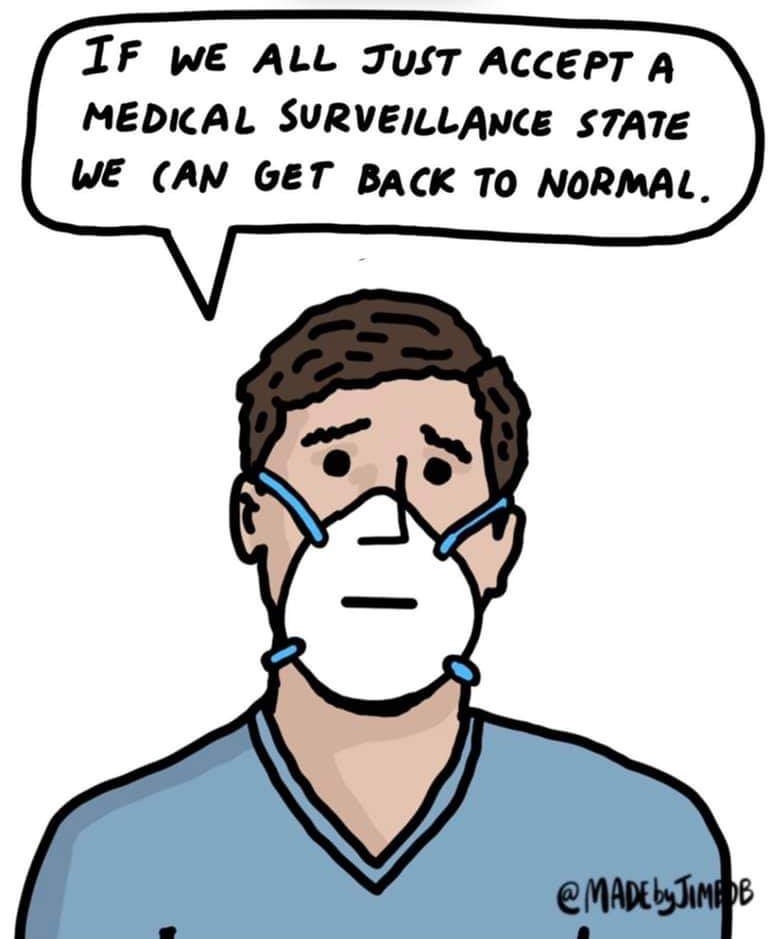
We’re told that life is never getting back to normal, so we need to suck it up and accept a world of mask-wearing, economic disruption, and social distancing. It’s a denatured echo of the warnings we’ve heard before that government responses to COVID-19 are pushing the world toward authoritarianism—but dressed up as if that’s a good thing.
That’s unfortunate, given that less-intrusive responses to the pandemic are proving at least as effective as heavy-handed ones. And that’s before we even discuss the inherent value of the freedom that looks destined to be pushed aside by public health concerns and by disingenuous government officials.
“As 2020 slides into and probably infects 2021, try to take heart in one discomfiting fact: Things are most likely never going ‘back to normal,'” wrote CNN International Security Editor Nick Paton Walsh last week. In his piece he discusses the likely permanency of mask mandates, telecommuting, reduced physical contact, and similar changes to life.
Some of the alterations Walsh mentions may be matters of personal choice, but a good many of them are imposed by “politicians who pretend that ‘normal’ is just around the corner,” as Babson College’s Thomas Davenport says in the article.
We’re supposed to accept our newly constrained lives as “the new normal”—in a phrasing that’s already very tired, indeed.
Actually, repeated references to a “new normal” aren’t just tired; they’re ominous.
Last Tuesday, while most Americans were distracted by the first US presidential debate, NPR quietly reported that the US government’s Operation Warp Speed, a public-private partnership launched by the Trump administration to rapidly develop and distribute a Covid-19 vaccine, had taken the unusual step of awarding contracts to vaccine companies, not directly, but through a secretive defense contractor.
Though NPR named thedefense contractor—South Carolina–based Advanced Technology International—they declined to explore the company’s deep ties to the CIA, Department of Homeland Security, and the Department of Defense and how ATI is helping to lead those agencies’ efforts to militarize health care and create a surveillance panopticon that not only monitors the world around us but our physiology as well.
The “secret” vaccine contracts awarded through ATI as part of Warp Speed total approximately $6 billion, accounting for the majority of Operation Warp Speed’s $10 billion budget. Both Paul Mango, Health and Human Services’ deputy chief of staff for policy, and Robert Kadlec, HHS assistant secretary for preparedness and response (ASPR), personally signed off on the contracts.
Operation Warp Speed, which officially involves the combined efforts of HHS and the military to deliver over 300 million Covid-19 vaccines to Americans by next January, is a highly secretive program dominated by military personnel, most of whom have no experience in health care or vaccine production. The Trump administration has often compared Warp Speed to the Manhattan Project, which produced the atomic bomb.
Several very unsettling revelations about the true nature and scope of Warp Speed, including the out-sized role of ATI, began to emerge starting last Monday. Yet, most of this new information was not covered by US news outlets due to the media frenzy surrounding the first presidential debate and the subsequent news that President Trump and several other politicians and White House officials had tested positive for Covid-19.
Some participants for leading COVID-19 vaccine trials have reported experiencing grueling side effects after receiving the shot — such as high fever, body aches, headaches and exhaustion.
Five participants — three in Moderna’s study and two in Pfizer’s late-stage trials — said the uncomfortable side effects usually went away within a day, but some were surprised by how severe they were, CNBC reported.
“If this proves to work, people are going to have to toughen up,” one of the Moderna participants, a North Carolina woman in her 50s who declined to be identified, told the outlet.
“The first dose is no big deal. And then the second dose will definitely put you down for the day for sure. … You will need to take a day off after the second dose.”
She said she didn’t experience a fever but had a bad migraine that left her exhausted and struggling to focus, the outlet reported. But the next day, she woke up feeling better after taking Excedrin.
While she was uncomfortable, the side effects outweigh the risks of becoming infected with the virus, she said.


 Hellbound and Down
You must be logged in to post a comment.