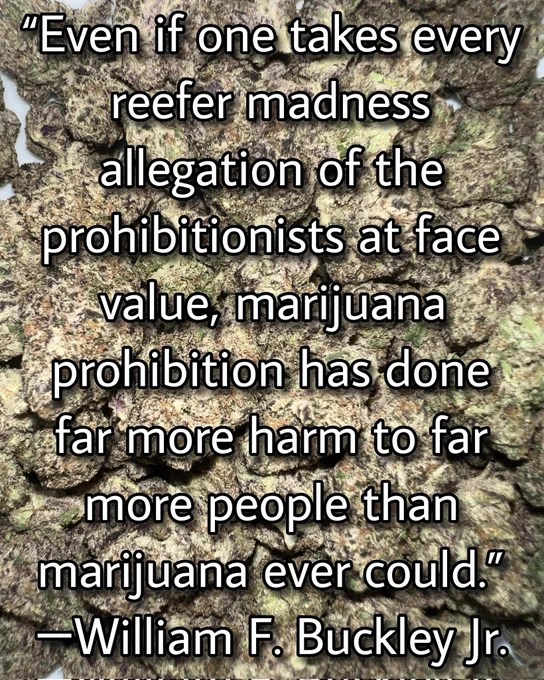
William F. Buckley, jr. on the war on (some) drugs…


For half a century, reformers have been urging the Drug Enforcement Administration (DEA) to reclassify marijuana, which since 1970 has been assigned to Schedule I of the Controlled Substances Act, the law’s most restrictive category. Although the DEA has always rejected that proposal, it could change course in light of a recent recommendation from the Department of Health and Human Services (HHS).
Last week, HHS recommended that the DEA move marijuana from Schedule I, which includes illegal drugs such as heroin, LSD, psilocybin, and MDMA, to Schedule III, which includes prescription medications such as anabolic steroids and Tylenol with codeine. Although that reclassification would facilitate medical research and indirectly benefit state-licensed marijuana businesses, it would leave federal prohibition essentially untouched.
Schedule I supposedly is reserved for drugs with “a high potential for abuse” that have no recognized medical applications and are so dangerous that they cannot be used safely even under a doctor’s supervision. Marijuana’s Schedule I status never made much sense, and the justification for that designation has become steadily weaker over the years.
Back in 1985, the Food and Drug Administration (FDA) approved Marinol—a synthetic version of THC, marijuana’s main active ingredient—as a treatment for nausea and vomiting caused by cancer chemotherapy. The FDA later extended that approval to AIDS wasting syndrome, and five years ago it approved Epidiolex, which contains cannabis-derived CBD, as a treatment for two forms of severe, drug-resistant epilepsy.
Research indicates that marijuana is effective at relieving various symptoms, including neuropathic pain and muscle spasms as well as nausea and epileptic seizures. Based on such findings, 38 states allow medical use of cannabis.
The Department of Health and Human Services (HHS) this week recommended that the Drug Enforcement Administration (DEA) move marijuana from Schedule I of the Controlled Substances Act, the most restrictive category, to Schedule III, where it would join medications such as Tylenol with codeine, buprenorphine, and anabolic steroids. The DEA has the final say on rescheduling decisions, and it is not clear whether it will agree with HHS, especially given its longstanding opposition to reclassifying marijuana, or how long it might take to decide. But if cannabis is eventually moved to Schedule III, that change would signal a new understanding of the drug’s risks and benefits. It also would facilitate cannabis research, and it would have important tax implications for state-licensed marijuana businesses. At the same time, it would leave federal marijuana prohibition essentially untouched.
The HHS recommendation is a product of the regulatory review that President Joe Biden ordered last October, when he also announced a mass pardon for people convicted of simple marijuana possession under federal law. At the time, Biden said “it makes no sense” to “classify marijuana at the same level as heroin,” and HHS evidently agrees. That category, which also includes psychoactive substances such as LSD, psilocybin, peyote, MDMA, and methaqualone, supposedly is reserved for drugs with a “high potential for abuse” that have no recognized medical use and cannot be used safely even under a doctor’s supervision.
Abuse potential is in the eye of the beholder. As the DEA tautologically sees it, any use of a prohibited drug is “abuse” by definition. But the notion that marijuana is so dangerous that it cannot be safely used “under medical supervision” is pretty perplexing, given that its side effects compare favorably to those of many prescription drugs. The idea that marijuana has “no currently accepted medical use in the United States” likewise is hard to reconcile with reality.
Contrary to decades of reefer madness propagated by our federal government, the Food and Drug Administration (FDA) now admits that marijuana does have accepted medical use. However, reports of the death of cannabis prohibition are exaggerated. No doubt, the conclusion of FDA’s scientific review of marijuana’s current Schedule I status is a welcome milestone in federal cannabis policy.
But while the Department of Health and Human Services’s (HHS) August 29, 2023 recommendation to the Drug Enforcement Administration (DEA) to reschedule marijuana based on FDA’s review will finally bring relief from the federal gross receipts tax levied on struggling state-licensed cannabis businesses, it also underscores the urgent need to both (1) continue pressing forward on descheduling efforts before critical momentum evaporates and certain industry stakeholders effectively settle for rescheduling without full decriminalization, and (2) demand that marijuana be exempted from existing categories of FDA-regulated products to preserve state medical and adult use cannabis markets.
Before proceeding, it’s important to remember that rescheduling would not apply the federal Food Drug and Cosmetic Act (FDCA) to marijuana for the first time—it applies right now, and like the federal Controlled Substances Act (CSA), would continue to apply after rescheduling. But absent any statutory authority permitting FDA to do otherwise, the FDCA would continue to apply after descheduling too, just as it does to hemp products. I previously noted this in “Cannabis Cannibalism: How Federal Rescheduling Could Consume the State-Licensed Industry Without Safe Harbors Under the Federal Food, Drug and Cosmetic Act,” available here.
However, moving marijuana from Schedule I to Schedule III will shift enforcement priorities (and the incentives to vigorously pursue these priorities) at both DEA and FDA. Indeed this has been the experience after the CSA’s prohibitions on hemp were relaxed beginning with the 2014 Farm Bill, and then scrapped under the 2018 Farm Bill which descheduled hemp by carving it out of the federal CSA’s definitions of “marijuana” and “THC.” Soon after, purveyors of hemp CBD products began receiving FDA cease-and-desist letters citing prohibited product claims and numerous grounds under the FDCA for prohibiting the interstate commerce in such cannabis products.
According to the Leafly Cannabis Harvest Report 2022, marijuana was the sixth most valuable wholesale crop in the United States last year at a $5 billion worth, trailing only corn, soybeans, hay, wheat and cotton.
The calculation includes only crops in states where state-sanctioned sales of legal weed are already up and running and exclude production in medical marijuana-only states.
Statista’s Katharina Buchholz reports that 2022 saw a cannabis harvest of 2,834 metric tons, up 24 percent from 2021.
Bloomberg News is reporting that U.S. Department of Health and Human Services Assistant Secretary for Health Rachel Levine has sent a letter to Drug Enforcement Administrator Anne Milgram asking her agency to reclassify marijuana (cannabis) as a Schedule III drug. The DEA defines Schedule III drugs as “drugs with a moderate to low potential for physical and psychological dependence.” The agency currently classifies marijuana as Schedule I: a drug “with no currently accepted medical use and a high potential for abuse.” Of course, that definition begs the question, “Currently accepted by whom?” But an even more important question is, “Why should a plant people have been growing and using recreationally for millennia be scheduled as a drug when alcohol is not?”
When Congress authorized the law enforcement agency to judge the clinical applications, efficacy, and potential dangers of drugs, it authorized cops to practice medicine. And they have been engaging in malpractice. For example, no serious person would argue that marijuana has “no currently accepted medical use.” As far back as 1916, Sir William Osler, the so‐called “father of modern medicine,” recommended cannabis as the “drug of choice” for treating migraines. But cannabis’s history of “accepted medical use” dates back to at least 2800 B.C.
The DEA also schedules diamorphine (brand‐named “heroin” by Bayer, its manufacturer in the 19th century) Schedule I even though it is legally used in the U.K. and much of the developed world to treat pain and is employed for medication‐assisted treatment of opioid use disorder (OUD) in Switzerland, the Netherlands, Germany, Canada, the U.K, Denmark, and Spain.
And even though a bipartisan consensus is emerging that psychedelics may be extremely helpful in treating post‐traumatic stress disorder, depression, addiction, and compulsive disorders, and in end‐of‐life care, the DEA placed them on Schedule I, depriving researchers, clinicians, and patients of these tools for 50 years.
The head of the top U.S. health agency is confirming news that his department is recommending marijuana rescheduling—posting about the development at exactly 4:20pm ET in an apparent wink to cannabis culture.
Amid a flurry of reactions to reports that the U.S. Department of Health and Human Services (HHS) is advising the Drug Enforcement Administration (DEA) to move cannabis from Schedule I to Schedule III, Secretary Xavier Becerra shared a post about it at the symbolic time on X (the social media site formerly known as Twitter).
If anyone thinks the timing is a coincidence, they probably haven’t been closely following Becerra’s account, as the Biden cabinet official has made a habit of talking about marijuana policy on social media at 4:20 on the dot.
On the day that President Joe Biden announced the scheduling review, for example, the secretary posted about his commitment to following through on the directive—at 4:20.
I used to wake up in the middle of the night, every night, with a nightmare. In it, my body was frozen, and trigger warning: In the nightmare, I was fading in and out of unconscious, but someone was raping me. They were textbook PTSD nightmares, and I had no idea what to do about them.
I was raised in the Caribbean, in the U.S. Virgin Islands, surrounded by ganja culture. While millennial “statesiders” my age I’d meet later when I moved to the South for school and then New York for my forever home, I realized that my childhood was different. Far from the “Just Say No” and D.A.R.E rhetoric my contemporaries experienced, many of my friend’s parents were Rastafarians. I grew up understanding that cannabis was a sacrament. So I spent high school, during the Bush era, on the debate team arguing for its legalization, and college majoring in journalism, reporting on cannabis. I’ve always been vehemently pro-legalization. But the reason cannabis didn’t become a big part of my personal life until a decade ago, in 2013, was because I was a total boozehound.
But alcohol made my PTSD stemming from my assault worse. Sometimes, back in the day, to be perfectly honest, it made me downright nasty or even suicidal. So my ambition kicked in, having seen what alcoholism can do to others (it runs in my family), and I quit. I haven’t had a drink in 10 years. I’ve been Cali Sober since before the term existed, baby.
So, a few years into sobriety, when a stoner close to my heart told me that people used cannabis to treat anxiety, PTSD and that THC could even suppress nightmares, at first, I was skeptical. Sure, it should be legal, just like alcohol, and the government is full of shit, but would it affect me like liquor did? Personally, 12-Step programs did more harm than good. I’m a big believer that a one-size-fits-all model is not suitable for recovery, something society finally seems ready to talk about.
Especially in the first few years after my assault, I needed to be shaken and reminded of my power — which had been robbed from me — instead of admitting I was powerless, which is, in so many words, the first step of AA. I’m glad the program works for many, including people I love, and I won’t even get into the fact that its founder, Bill W., fully embraced psychedelics at the end of his life, adamant that they could treat alcoholism. Because this story is about why recreational use and medical use have more overlap than the establishment makes them out to.
The use of cannabis doesn’t raise one’s risk of psychosis or other adverse health outcomes, even among adolescents who are at high risk for the disorder, according to longitudinal data published in the journal Psychiatry Research.
A team of researchers affiliated with Hofstra University in New York and with Stanford University in California assessed the relationship between cannabis use and health outcomes in a cohort of adolescents at clinical high risk for psychosis. Study participants were tracked for two years.
Investigators reported that those subjects who consumed cannabis were no more likely than non-users to become psychotic.
Authors concluded: [C]ontinuous cannabis use over 2-years of follow-up was not associated with an increased psychosis transition rate, and did not worsen clinical symptoms, functioning levels, or overall neurocognition … indicating that CHR [clinical high risk] youngsters are not negatively impacted by cannabis. … These findings should be confirmed in future clinical trials with larger samples of cannabis using individuals.”
The findings are similar to those published in April in the journal Psychiatry and Clinical Neurosciences. That study also failed to identify cannabis use as a risk factor for psychosis in clinically at-risk subjects. The study’s authors concluded: “Our primary hypothesis was that cannabis use in CHR [clinically high risk] subjects would be associated with an increased rate of later transition to psychosis. However, there was no significant association with any measure of cannabis use. … These findings are not consistent with epidemiological data linking cannabis use to an increased risk of developing psychosis.”
 Hellbound and Down
You must be logged in to post a comment.