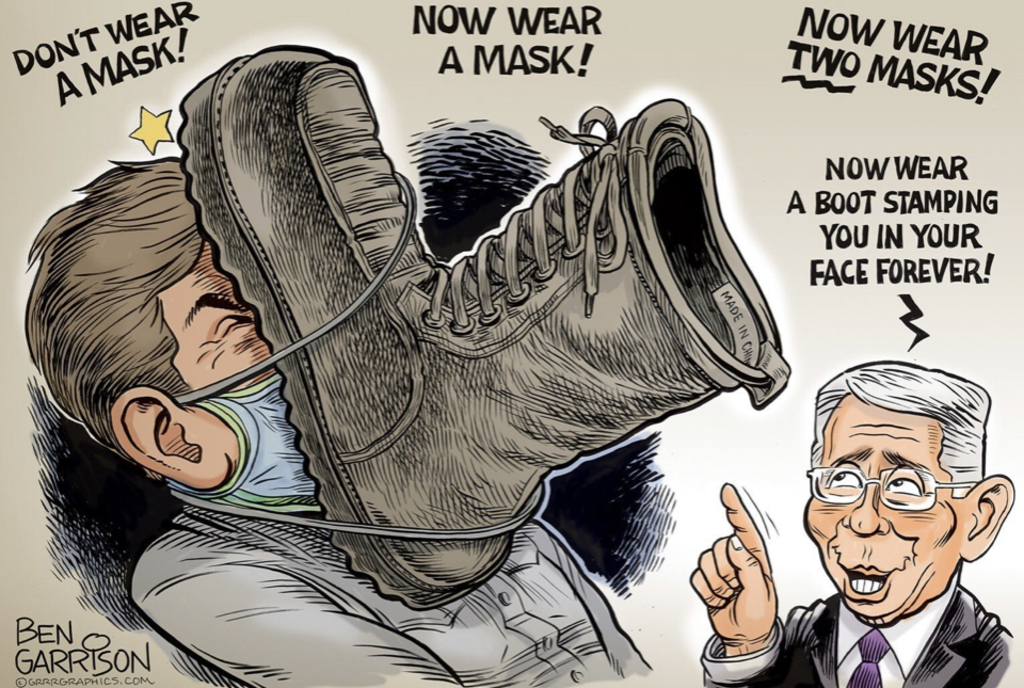
You’ve got a Fauci on your back…


In May 1983, amid the rapidly escalating AIDS crisis, a doctor at the National Institutes of Health (NIH) promoted a stunning theory about the newly encountered disease in the Journal of the American Medical Association (JAMA). Noting that the same issue of the journal contained an article documenting one of the first cases of the immunodeficiency disease’s appearance in an infant, the author sounded an alarm about “the possibility that routine close contact, as within a family household, can spread the disease.”
The article took an increasingly speculative turn in promoting this new theory. “If indeed the latter is true, then AIDS takes on an entirely new dimension,” it continued. “If we add to this possibility that nonsexual, non-blood-borne transmission is possible, the scope of the syndrome may be enormous.” Although the article reiterated the need to “be cautious” in accepting these findings as they awaited more evidence, the discovery “should at least alert us to the possibility that we are truly dealing with AIDS in children,” as transmitted through routine interaction.
The author of the article has since attained widespread familiarity. It was Dr. Anthony S. Fauci, a rising star within the NIH bureaucracy.
In 2003, terrorism was a more immediate national danger than infectious diseases. Dr. Anthony Fauci’s National Institute of Allergy and Infectious Diseases (NIAID) had just redirected $117 million from infectious diseases to fund a new anthrax vaccine effort in response to the anthrax attacks that happened a week after 9/11.
The millions were just a small part of the $1.8 billion Fauci had poured into defense from bioterrorist attacks over the preceding two years. More than half of those funds were devoted to anthrax and smallpox alone. In 2004, Fauci launched the $5.6 billion “Project Bioshield,” the National Institutes of Health’s biggest outlay for a single research issue until then.
Some microbiology researchers at the time, however, according to the journal Nature, were concerned that Fauci’s actions would ultimately “distort priorities in infectious-disease research, sucking money away from work to understand and counter natural disease outbreaks that ultimately pose a greater threat to public health.” The 2003 Nature article cited a Stanford University microbiologist saying “that diseases such as influenza and other respiratory-tract infections routinely kill far more people than would die in a bioterrorist attack, and therefore deserve a greater share of the NIAID budget.”
The criticism turned out to be warranted. In 2007, after spending billions under the opposite premise, Fauci admitted that “at the end of the day, you’re not going to kill as many people [with an anthrax attack] as you would if you blasted off a couple of car bombs in Times Square.” His anthrax vaccine effort had failed, having been “sunk by lobbying.”
The anthrax vaccine failure followed on the heels of Fauci’s controversial leadership of the nation’s AIDS response in the 1980s and ‘90s. According to “Good Intentions,” a 1990 book by investigative author and innovation expert Bruce Nussbaum, Fauci started his career as “a lackluster scientist,” who “found his true vocation—empire building” when he took the reins at NIAID in 1984.
To ensure that AIDS would be his exclusive demesne within the federal government, Fauci “started the most important bureaucratic battle in the history of the fight against AIDS,” squeezing out more scientifically competent, but less conniving administrators. According to Nussbaum, if Fauci had not won the battle, “many people who died might have lived.”


According to a Newsweek piece written in 2019, the National Institutes of Health (NIH), and the Fauci-led National Institute for Allergy and Infectious Diseases (NIAID), committed $3.7 million dollars to research bats and coronaviruses in China over a six-year period.
It’s worth noting in that particular Newsweek piece, the US intelligence backtracked from their earlier claims that the Coronavirus outbreak occurred “naturally,” and conceded that the pandemic “might” have started from a leak in the Wuhan lab.
But this new research wasn’t just about bats. It went deeper and darker than that. As a matter of fact, Dr. Fauci was among the first to fund the controversial “Gain of Function” ferret research in Wuhan, China. Fauci was so committed to the controversial work that back in 2011 he wrote an op-ed in The Washington Post, entitled, “A Flu Virus Risk Worth Taking,” where he vigorously defending “Gain of Function” research.
But something very interesting took place right before Obama’s moratorium on “Gain of Function” took effect.
Dr. Fauci had commissioned a study to assess the risk of new Coronaviruses emerging from wild animals. Fauci wanted to see what viruses could infect animals and humans. The directive behind the research and written in the project summary was “Gain of Function” manipulation.
But the Obama admin was getting cold feet about the program.
While many in the scientific community (like Fauci) were very excited by “Gain of Function” research, the more popular it became, the more scrutiny it received, and significant security issues were being raised. Eventually, the controversy got to be too much and in 2014 the United States pulled the plug.
NPR reported that the Obama administration was concerned about any research that could make the viruses more dangerous, so they wanted to stop and review studies to see if they could make these germs capable of causing more disease or spreading easily through the air.
It’ll be a long, seven years before the COVID-19 pandemic is over worldwide, if vaccine distribution continues at its current rate, a calculation from Bloomberg shows.
The media outlet, which said it built the “biggest database” of COVID-19 inoculations given across the globe, crunched the numbers and found it could take most of a decade to reach herd immunity if distribution doesn’t ramp up for two-dose vaccines.
Dr. Anthony Fauci has said 70-85 percent of the population will need the vaccine in order to achieve herd immunity and while the US is on track to reach that goal by the New Year in 2022, it could take countries like Canada ten years at their current pace.


You must be logged in to post a comment.