Be Skeptical of ‘Beneficially Coercive’ New Rules for Booze

A new warning from Surgeon General Vivek Murthy that links alcohol to cancer ought to raise questions about the purpose of such public health edicts—especially in the wake of the COVID-19 pandemic, which saw a dramatic decline in Americans’ willingness to trust such expertise.

Is the goal of public health to provide scientifically accurate information so Americans can understand the risks and trade-offs that are an inevitable part of life?

Or is the goal to change public behavior to eliminate risk, and to force that change if people are unwilling to go along?

Writing in The New York Times, physician Rachael Bedard argues for the latter. She likens Murthy’s new warning about alcohol to vaccine mandates: A “beneficially coercive” policy that “can evolve over time as people get used to new expectations and restrictions.”

“The way that public health most effectively helps people change their habits is by changing the incentives, pressures, and opportunities in the culture around them,” she writes—as if human beings were wild animals that the state is charged with domesticating, rather than rational actors with free will.

But Bedard is merely stating the quiet part out loud—even as she admits that “a majority of Americans might not be in the mood for the surgeon general’s advice.” Indeed, she also acknowledges that the surgeon general’s report isn’t meant to convince ordinary Americans to change their behavior—like her husband, who apparently rolled his eyes when told about the advisory. Rather, these “recommendations, like the one to change alcohol labeling to highlight cancer risk, are policy ideas.”

In other words, they’re not meant to convince you to do anything differently. They are meant to convince policymakers, who will then make the decision for you.

It’s a safe bet that Americans are in no mood to be scolded by public health officials these days, when the noble liesshifting science, and officially authorized misinformation from the pandemic is still fresh in mind.

That would be true even if Murthy’s edict was based on sound science.

It’s not. Murthy’s report claims that drinking beer, wine, and liquor is “a leading preventable cause of cancer in the United States” and that “evidence shows that this risk may start to increase around one or fewer drinks per day.”

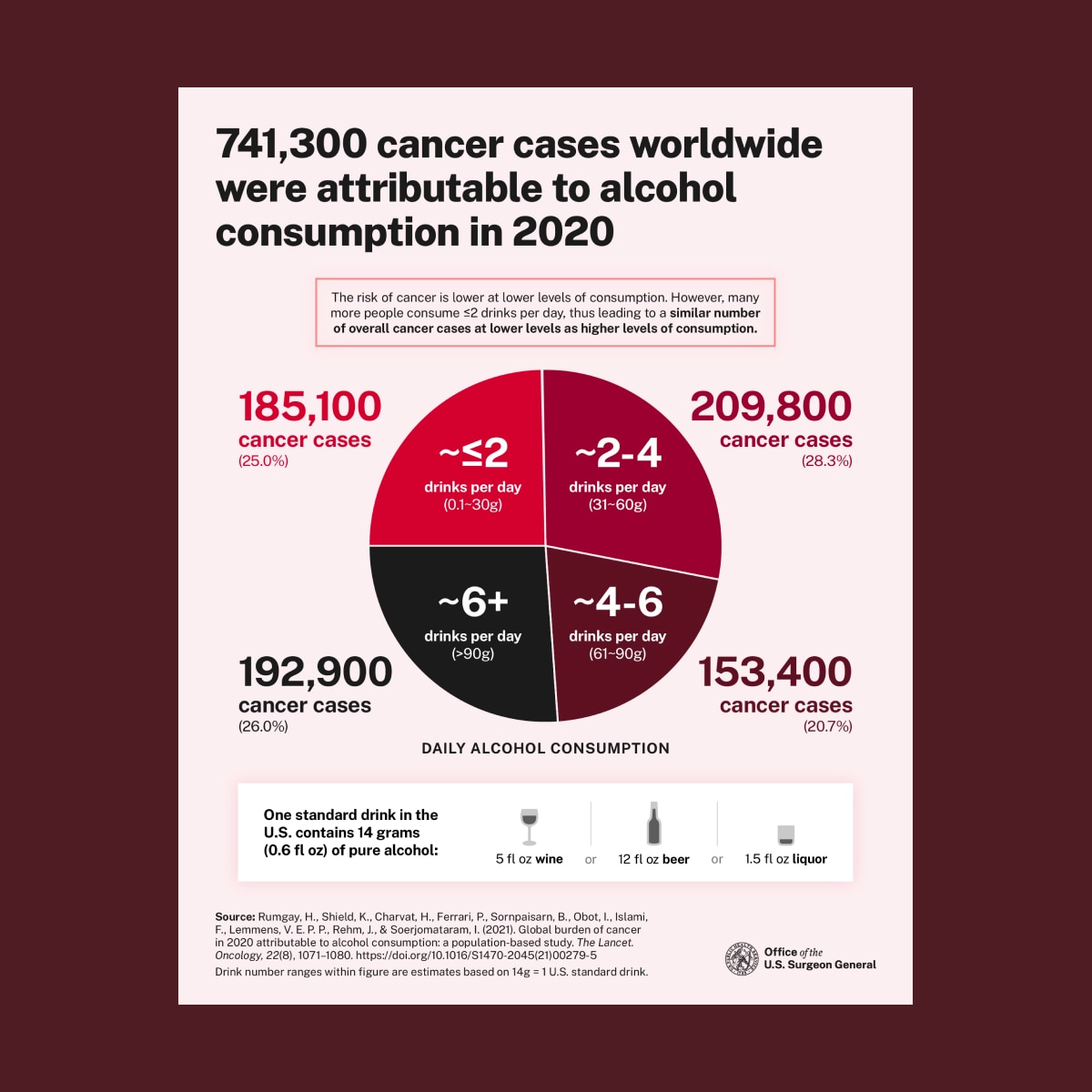
The evidence actually tells a far more complex story. Of the more than 740,000 cases of cancer worldwide in 2020 that Murthy says could have been prevented by abstaining from alcohol, more than 75 percent were attributable to people who had more than two drinks per day. 

Keep reading

Beer Lobby Wants Restrictions and Higher Taxes on Intoxicating Hemp Products

A trade group representing the American brewing industry released proposals on how Congress should regulate its competitors. Unsurprisingly, they recommend a heavy hand.

The Beer Institute is a trade organization that “represents the beer industry before Congress, state legislatures and public forums across the country…as the recognized and authoritative source of information on aspects of the industry.” Last week, it released a list of “guiding principles” calling for restrictions on intoxicating CBD products.

“The Beer Institute supports efforts underway by lawmakers to close an unintended federal loophole that is enabling the proliferation of unregulated intoxicating hemp products across the country, including those containing synthetically derived THC,” the statement said. “Intoxicating hemp and cannabis products are fundamentally different than beer and the taxation of them by government entities should reflect these stark differences just as governments at all levels in the United States have consistently reaffirmed the different tax treatment between beer, wine and hard liquor.”

While marijuana remains illegal at the federal level, Congress inserted a provision into the 2018 farm bill legalizing hemp by defining it as part of the cannabis plant containing “not more than 0.3 percent” delta-9 THC, the psychoactive ingredient in marijuana. Soon thereafter, chemists began to manufacture intoxicating products with CBD derived from hemp that contained delta-8, a milder form of THC not mentioned in the farm bill.

The industry for intoxicating hemp-derived products exploded, and state laws have struggled to catch up. “State regulations governing hemp products vary widely and are unevenly enforced, creating a patchwork of rules that can change dramatically from one state to the next,” according to a policy brief by Geoffrey Lawrence and Michelle Minton of the Reason Foundation, the nonprofit that publishes this magazine. There are currently no federal laws that specifically address these products, including their legality—they are simply assumed to be legal based on the phrasing of the farm bill, and Congress has struggled to pass an updated version for more than a year.

In its guidelines, the Beer Institute takes no position on marijuana’s legality, merely allowing that “the legalization of consumable cannabis products is for American voters, state legislatures and Congress to decide.” But if and when Congress does get around to addressing intoxicating hemp products, the group recommends it pull no punches.

“If legalized, the Beer Institute supports the establishment of a federal excise tax rate on intoxicating hemp and cannabis, with the tax rate set higher than the highest rate for any beverage alcohol product,” the guidelines stipulate. “Regulators at the federal, state, and local levels should prohibit co-location of the sale of alcohol beverages in the same retail venues as intoxicating hemp and cannabis products, if legalized, and further, to avoid consumer confusion, intoxicating hemp and cannabis products, if legalized, should only be sold in dispensaries.”

Keep reading

Beer Industry Trade Group Applauds California Governor’s Crackdown On Hemp Products With THC

A major alcohol trade association is applauding California Gov. Gavin Newsom’s (D) newly proposed emergency regulations to outlaw intoxicating hemp-derived cannabinoids and require all CBD products be completely free of THC.

The head of the Beer Association, which represents American brewers, importers and industry suppliers, touted its “longstanding commitment to responsible drinking” in comments issued Monday morning and said Newsom’s proposal will close “an unintended loophole” created with the passage of the 2018 Farm Bill, which legalized hemp federally.

“The Beer Institute thanks Governor Newsom for his leadership in closing an unintended loophole that has enabled the proliferation of unregulated intoxicating hemp products,” Brian Crawford, the group’s president and CEO, said in a statement. “Intoxicating hemp products are being sold as food and beverages, despite not being deemed safe for the U.S. food supply by federal regulators, and in some cases without age restrictions.”

“The beer industry is proud of our longstanding commitment to responsible drinking,” added Crawford, “and to operating in full compliance with a multitude of state and federal regulations.”

The Beer Institute said in an email that its position “aligns with a bipartisan coalition of 21 state attorneys general” who wrote a letter in March urging Congress to amend federal law so that intoxicating cannabinoids are not included in the federal definition of hemp.

More broadly, the Beer Institute has kept its distance from marijuana. It says on a policy page that while members “strongly believe voters should determine whether their state should legalize the sale of marijuana,” the group itself remains neutral on legalization. It further argues that it’s “misleading to compare marijuana to beer.”

“Beer is distinctly different, both as a product and as an industry,” the trade association contends. “Americans welcome beer at nearly every occasion because beer’s moderate alcohol content means it can be enjoyed sensibly. Brewers and beer importers are committed to responsible consumption, advertising, community service and working with law enforcement to promote public safety.”

Keep reading

Marijuana Legalization Is A ‘Significant Threat’ To Alcohol Industry Because People Substitute Cannabis For Beer And Wine, Analysis Finds

Financial analysts say they expect the expansion of the marijuana legalization movement will continue to post a “significant threat” to the alcohol industry, citing survey data that suggests more people are using cannabis as a substitute for alcoholic beverages such a beer and wine.

A report from Bloomberg Intelligence (BI) projects that slumping sales of wine and spirits “may extend indefinitely,” which will “stem largely” from the increased consumer access to “legal cannabis,” as well as rising popularity of made-to-go drinks, for example.

They estimated that the combined influence of cannabis access and shifts in consumer demand for certain alcoholic product types accounts for a 16 percent share valuation discount offered by the beverage company Constellation Brands, which owns major brands including Corona, Modelo, Pacifico and Casa Nobel Tequila.

“The use of cannabis among consumers is on the rise, and we believe it’s being substituted for alcoholic beverages” based on an August 21 survey from BI involving 1,000 adults, it said. “We also anticipate that increasing US consumer access to recreational marijuana will be a significant threat to all alcoholic drinks, particularly beer and wine, given their lower price points relative to liquor.”

According to the survey, nearly half of respondents reported using cannabis as an alcohol substitute at least once per week. Additionally, 22 percent said they use marijuana more often than alcohol.

Meanwhile, a multinational investment bank similarly said in a report late last year that marijuana has become a “formidable competitor” to alcohol, projecting that nearly 20 million more people will regularly consume cannabis over the next five years as booze loses a couple million drinkers. It also says marijuana sales are estimated to reach $37 billion in 2027 in the U.S. as more state markets come online.

Keep reading

Psychedelics Have ‘Demonstrated Potential For Treating Drug Addiction’ And Alcoholism, New Research Shows

Two new studies on psychedelics and alcoholism—including one with contributions from a top federal drug official—offer hope for new ways to treat alcohol use disorder (AUD).

One says a single dose of psilocybin “was safe and effective in reducing alcohol consumption in AUD patients,” while the other concludes that classic psychedelics like psilocybin and LSD “have demonstrated potential for treating drug addiction, especially AUD.”

The first study looked at 10 treatment-seeking adults “with severe AUD,” according to a preprint version of the research published online at Research Square. After a single 25 milligram dose of psilocybin, “alcohol consumption significantly decreased” during a 12-week period, the team found.

Coauthored by National Institute on Drug Abuse (NIDA) Director Nora Volkow—in her role at the National Institute on Alcohol Abuse and Alcoholism’s neuroimaging laboratory—along with 10 researchers at the University of Copenhagen, in Denmark, the open-label study found that most participants craved alcohol less and consumed fewer drinks following treatment with psilocybin.

“Participants reported a decrease from baseline to week 1 in alcohol craving,” the paper says—a decrease that was sustained four weeks and 12 weeks after the psychedelic was administered. “Further, participants reported an immediate change from baseline to week 1 in self-efficacy, i.e. confidence in the ability to abstain from alcohol.”

Keep reading

Major Alcohol Industry Group Pushes Congress For ‘Critical Action’ To Regulate Consumable Hemp Products, Rather Than Ban Them

A major alcohol industry association is calling on congressional leaders to create a regulatory framework for hemp-based intoxicating cannabinoids—rather than impose an outright ban as is proposed under a large-scale agriculture bill that’s advancing in the House.

In a letter sent to House and Senate Agriculture Committee leaders on Wednesday, Wine & Spirits Wholesalers of America (WSWA) urged “critical action to ensure that intoxicating hemp products sold across the country are safe for consumers” as lawmakers work to advance the 2024 Farm Bill.

“We strongly advocate for clear federal rules and regulations that define intoxicating hemp compounds and to grant states the authority to regulate these products within their borders,” the alcohol trade association said.

The letter comes about a week after the House Agriculture Committee approved an amendment to the 2024 Farm Bill that would effectively ban most consumable hemp products—a proposal that saw some ideological splintering within the cannabis sector.

Ahead of that vote, WSWA said the “attempt to ban intoxicating hemp products is merely doubling down on the failed federal policy of prohibition.” But in this latest letter, the association used more tempered language. While it said a regulatory framework would be ideal, it also suggested Congress could enact legislation that also allows individual states to ban the products altogether.

Keep reading

San Francisco buys vodka shots for homeless alcoholics in taxpayer-funded program

The City of San Francisco is providing free beer and vodka shots to homeless alcoholics at taxpayer expense under a little-known pilot program. 

The “Managed Alcohol Program” operated by San Francisco’s Department of Public Health serves regimented doses of alcohol to voluntary participants with alcohol addiction in an effort to keep the homeless off the streets and relieve the city’s emergency services. Experts say the program can save or extend lives, but critics wonder if the government would be better off funding treatment and sobriety programs instead.

“Established in countries such as Canada and Australia, a managed alcohol program is usually administered by a nurse and trained support staff in a facility such as a homeless shelter or a transitional or permanent home, and is one method to minimize harm for those with alcohol use disorder,” the California Health Care Foundation explains in an 2020 article describing the pilot program. 

“By prescribing limited quantities of alcohol, the model aims to prevent potentially life-threatening effects of alcohol withdrawal, such as seizures and injuries.” 

Keep reading

Tennessee Man’s Illegal Moonshine Operation Yielded 81 Quarts

A man in Johnson City, Tennessee, has been cited after law enforcement found an illegal moonshine operation.

Officials cited 36-year-old Jeremy Stines in the case and WCYB reported Monday that a tip led authorities to discover the operation that was apparently located inside a barn.

In a social media post, the Washington County Sheriff’s Office of Tennessee (WCSO) noted Stines was cited for manufacture of alcoholic beverages, possession of a still, and unlawful storage of liquor for sale.

The sheriff’s office continued:

Upon receiving the tip, Investigators conducted a premise check in the 200 block of Highridge Road. It was disclosed by Stines that there was in fact a still in the yard barn at the east end of the property, and verbal consent was given by Stines to search the building. The liquor manufacturing equipment, along with 81 quarts of product, were seized transported to WCSO.

According to Tennessee Code Annotated § 39-17-707, it is unlawful for any person to have possession or control of any still or other apparatus, or part of a still or other apparatus to be used for the purpose of manufacturing intoxicating liquor as prohibited by law. Possession of a Still is a Class B misdemeanor.

Manufacture of Alcoholic Beverages and Unlawful Storage of Liquor for Sale are both Class A misdemeanors.

Stines is scheduled to appear in court on March 5 regarding the case.

Keep reading

Connecticut Marijuana Retailers Can Open On Christmas And New Year’s, But Alcohol Stores Must Close

People in Connecticut can’t legally buy alcohol on Christmas or New Year’s Day, the state Department of Consumer Protection reminded residents this week—but cannabis is A-OK.

“If you choose to consume alcohol with your holiday celebrations, be sure to make those purchases ahead of time, and, of course, please drink responsibly,” Department of Consumer Protection (DPC) Commissioner Bryan T. Cafferelli said in a statement on Wednesday. “And, because we regulate many things you may be wondering about, Connecticut Law does not prohibit the sale of cannabis, or limit your ability to place wagers during the holidays.”

“No matter how you choose to spend the holidays,” he added, “please know your limit, arrange designated drivers and be respectful of the establishments and communities where you celebrate.”

On both New Year’s and Christmas Day, state law prohibits package stores from opening, and grocery stores are barred from selling beer. To-go sales of liquor are also banned.

“Hours for cannabis licensees,” said the Department of Consumer Protection, “are unaffected.”

Keep reading

Marijuana Will Gain Millions Of Consumers Over Alcohol, With Sales Hitting $37 Billion By 2027, Investment Bank Projects

A multinational investment bank says that marijuana has become a “formidable competitor” to alcohol, projecting that nearly 20 million more people will regularly consume cannabis over the next five years as booze loses a couple million drinkers. It also says marijuana sales are estimated to reach $37 billion in 2027 as more state markets come online.

An analysis from the firm TD Cowen says marijuana sales reached $29 billion in 2023, which is approximately 11 percent of what the alcohol industry brought it. That’s up from four percent just five years ago, and marijuana is expected to grow by another seven percent annually over the next five years.

“As such, we believe that over the next 5 years, the cannabis category will add 18 million past-month consumers, while alcohol will lose 2 million past-month consumers, as consumers increasingly embrace cannabis and temper their alcohol consumption,” the report, titled “Cannabis Beats Booze,” says.

Vivien Azer, team lead on the analysis, told Marijuana Moment that the report bolsters a growing body of market research.

“We’ve been calling for seven years now for cannabis to increasingly prove as a dislocator to alcohol sales—and, really, it’s just a matter of time,” she said. However, she said it was “a little surprising” to see data projecting an even greater underperformance for alcohol sales in legal marijuana states.

While marijuana sales are still just a fraction of the dominant alcohol market, analysts say that there’s reason to believe that booze could be “at risk” of declining because of increased substitution among consumers, particularly young people. The TD Cowen report cited a proprietary survey that found more than two-thirds of cannabis users report reducing alcohol consumption.

Keep reading