Sweden shows lockdowns were unnecessary. No wonder public health officials hate it

You know who isn’t worried about a second wave of COVID-19? Sweden. The stolid Scandinavian kingdom has just carried out a record number of COVID-19 tests and found a positive rate of just 1.2%, the lowest since the start of the pandemic. As Sweden’s case rate drops below Norway’s and Denmark’s, those commentators who spent April and May raging against what a Washington Post op-ed called its “experiment with national chauvinism” and predicting colossal fatalities have suddenly gone quiet.

“Sweden has gone from being one of the countries with the most infection in Europe to one of those with the least infection in Europe, while many other countries have seen a rather dramatic increase,” says Anders Tegnell, the state epidemiologist.

True, and it has happened not despite the absence of a lockdown but because of it. Sweden encouraged people to work from home, made university courses remote, and banned meetings of more than 50 people but otherwise trusted its citizens to use their common sense. The authorities judged that since hospitals could cope, there was no need to buy time by ordering people to stay indoors. That judgment has been amply vindicated.

A cause for unalloyed joy, you might think. Here, after all, is proof that a country can contain the coronavirus without depriving children of an education, piling up backlogs of non-coronavirus medical conditions, or leaving a smoking crater where its economy used to be.

But the rest of the world is far from pleased. Indeed, the tone of most foreign media coverage remains affronted, and you can see why. After all, if Sweden’s strategy was viable, the rest of us ruined ourselves for nothing. That is a disquieting thought, almost an unbearable one. But Sweden forces us to confront it.

Keep reading

Sweden’s disease expert says just wearing face masks could be ‘very dangerous’

Sweden’s top infectious disease expert has resisted recommending face masks for the general population — arguing it’s “very dangerous” if people believe the coverings alone will stop the spread of the coronavirus.

Anders Tegnell, chief epidemiologist at Sweden’s Public Health Agency, has repeatedly expressed skepticism that face masks will control virus outbreaks, the Financial Times reported.

“It is very dangerous to believe face masks would change the game when it comes to COVID-19,” said Tengell, who is considered the country’s equivalent of Dr. Anthony Fauci from the White House COVID-19 task force.

He noted that countries with widespread mask compliance, such as Belgium and Spain, were still seeing rising virus rates.

Keep reading

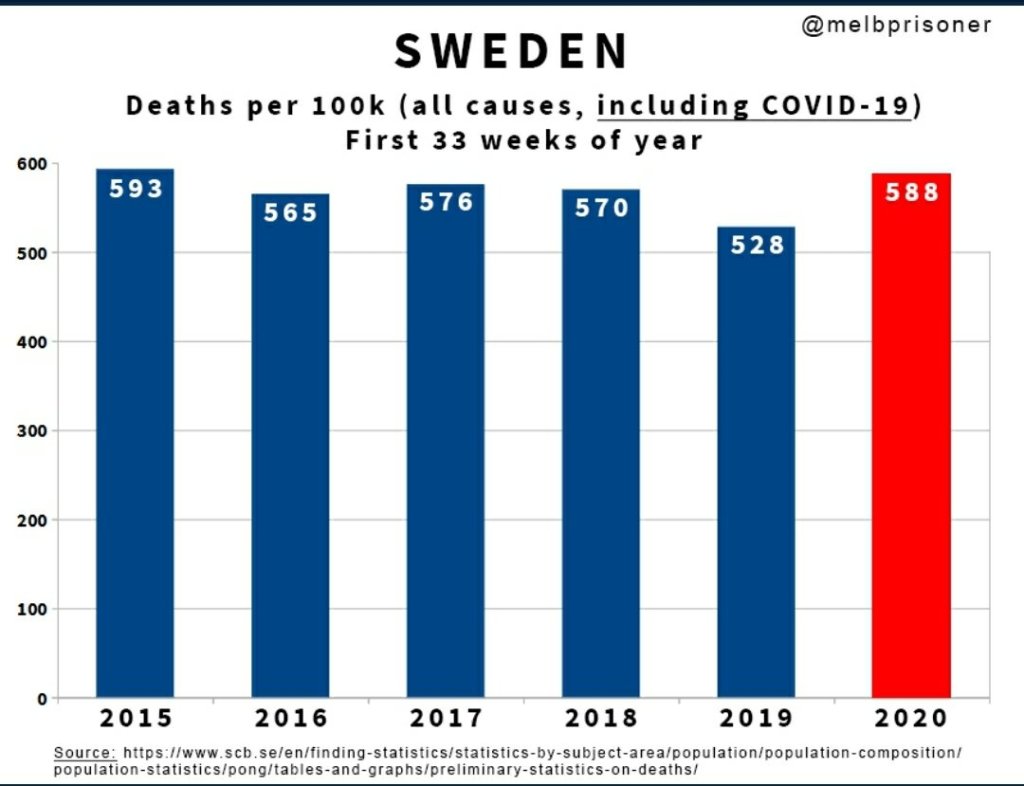
Sweden: The One Chart That Matters

Sweden has been harshly criticized in the media for not imposing draconian lockdowns like the United States and the other European countries. Instead, Sweden implemented a policy that was both conventional and sensible. They recommended that people maintain a safe distance between each other and they banned gatherings of 50 people or more. They also asked their elderly citizens to isolate themselves and to avoid interacting with other people as much as possible. Other than that, Swedes were encouraged to work, exercise and get on with their lives as they would normally even though the world was still in the throes of a global pandemic.

The secret of Sweden’s success is that its experts settled on a strategy that was realistic, sustainable and science-based. The intention was never to “fight” the virus which is among the most contagious infections in the last century, but to protect the old and vulnerable while allowing the young, low-risk people to circulate, contract the virus, and develop the antibodies they’d need to fight similar pathogens in the future. It’s clear now that that was the best approach. And while Sweden could still experience sporadic outbreaks that might kill another 2 to 300 people, any recurrence of the infection in the Fall or Winter will not be a dreaded “Second Wave”, but a much weaker flu-like event that will not overwhelm the public health system or kill thousands of people.

Keep reading

Sweden’s Top Epidemiologist: ‘We See No Point In Wearing Masks’

Sweden’s top epidemiologist says he sees “no point” in mandating masks in public across the country, which has seen its COVID-19 numbers plunge in recent months.

“With numbers diminishing very quickly in Sweden, we see no point in wearing a face mask in Sweden, not even on public transport,” Anders Tegnell said, according to Fortune.

Newsweek reports that as of Sunday, “the latest death rate in Sweden (deaths per 100,000 people) was reported to be 56.40. The figure is lower than that reported in the U.K. (69.60), Spain (60.88) and Italy (58.16), according to the latest report Sunday by Johns Hopkins University.”

“That Sweden has come down to these levels is very promising,” Tegnell told reporters in Stockholm on Tuesday. “The curves are going down and the curves for the seriously ill are beginning to approach zero.”

Keep reading

Sweden riding high and the triumph of the rational herd immunity approach

On Tuesday, Sweden reported 0 deaths and just 77 cases. Over the past week, deaths have been no higher than two per day. What is so remarkable is that while there are other countries that have had near-zero deaths for even longer, Sweden has achieved this through herd immunity; prevented the lockdown deaths, emotional abuse, drug deaths, suicides, and financial ruin plaguing other countries; and – most importantly – is more fortified against a resurgence than these other countries that delayed herd immunity.

Keep reading

Sweden, Which Never Had Lockdown, Sees COVID-19 Cases Plummet as Rest of Europe Suffers Spike

Amid fears over a potential second wave of the novel coronavirus across Europe, new infections in Sweden, where full lockdown measures were not implemented, have mostly declined since late June.

The number of new cases per 100,000 people in Sweden reported over the last 14 days since July 29 dropped by 54 percent from the figure reported over 14 days prior to then, according to the latest report Wednesday from the World Health Organization (WHO).

Meanwhile, other parts of Europe have reported large spikes in new cases over the same period, including Spain, France, Germany, Belgium and The Netherlands, which have seen increases between 40 and 200 percent over the last month, according to the latest WHO report Wednesday.

Keep reading…

The Economic Performance of Coronavirus Sweden

In Iceland, aggressive track-and-trace policies, effective quarantining, and closed borders had the country’s infection peak in early April. Soon enough we all forgot about them and their single-digit deaths. 

Instead Sweden became the black sheep. The stubborn outlier kept its society comparatively open. Shops and cafés and workplaces introduced some changes, like putting screens between customers and shop-workers. The Scandinavian nation leveraged its high internet accessibility to work from home, and public policy and persona alike appealed to common-sense behavior – like staying at home if ill, keeping physical distance, and using sanitizer (though not as religiously as the Icelanders). 

While pundits of either ideological persuasion lined up to defend it or attack it, Sweden’s elderly population kept dying. The strategy’s focus on openness, we were told, was directly to blame for care homes being unable to shield their vulnerable residents. 

Except, it turned out, that the elderly and those in nursing homes elsewhere were dying all the same: in New York, in England, in Italy, in New Orleans, stringent government restrictions or not.

Keep reading

Sweden Defeated The Coronavirus Without A Lockdown – Now Its Companies Are Reaping The Benefits

Progressive critics of the Trump Administration’s response to the coronavirus pandemic like to point to Sweden and portray the Nordic country’s decision to forego lockdowns as a travesty motivated by greed. Such reductive, black-and-white interpretations are inevitably the result of a childlike analysis where every hero needs to have a hero and a villain. But although Sweden’s COVID-19 czar has admitted that he would have changed certain elements of the country’s response if he could go back in time, the country’s decision to skip lockdowns, and keep the country relatively open, has paid off – even if Sweden does have a significantly higher mortality rate than its neighbors (though still lower than all of the worst-hit western European countries).

Keep reading