
Spend it wisely, peeps…

Buried in the enormous spending/COVID-19 relief package that Congress approved this week is a bill that imposes new restrictions on the distribution of all vaping equipment, parts, and supplies, including a ban on mailing them. The provision illustrates not only how utterly irrelevant legislation can be slipped into unread, must-pass bills but also how Congress redefines reality through legal fictions and uses save-the-children rhetoric to justify restricting adults’ choices.
Title VI of the 2021 Consolidated Appropriations Act, which appears on page 5,136 of the 5,593-page bill, is called the Preventing Online Sales of E-Cigarettes to Children Act. The bill was introduced last April by Sen. Dianne Feinstein (D–Calif.), joined by seven original cosponsors: six Democrats plus Sen. John Cornyn (R–Texas). It includes two changes aimed at complicating and obstructing online sales of vapes and e-liquid.
Feinstein’s bill amends the Jenkins Act of 1949, which requires that vendors who sell cigarettes to customers in other states register with the tax administrators in those states and notify them of all such sales so they can collect the taxes that the buyers are officially obligated to pay. In 2002, the General Accounting Office (now the Government Accountability Office) found that online cigarette sellers routinely flouted the Jenkins Act and that the federal government had done virtually nothing to enforce it. Nine years later, Congress amended the law, beefing up its reporting requirements and extending it to cover roll-your-own tobacco.
The longest piece of legislation in United States history, containing both a coronavirus relief package and the annual omnibus spending package, quickly passed through Congress on December 22, with little opposition. While technically separate bills, the omnibus and stimulus were debated and passed together, at the same time.
The massive piece of legislation — a staggering 5,593 pages in length — lays bare the priorities of the US government, prioritizing regime change in foreign nations and the imperatives of empire over the basic needs of Americans.
In just a few hours, it passed through the House of Representatives by 359-53, and through the Senate by 92-6.
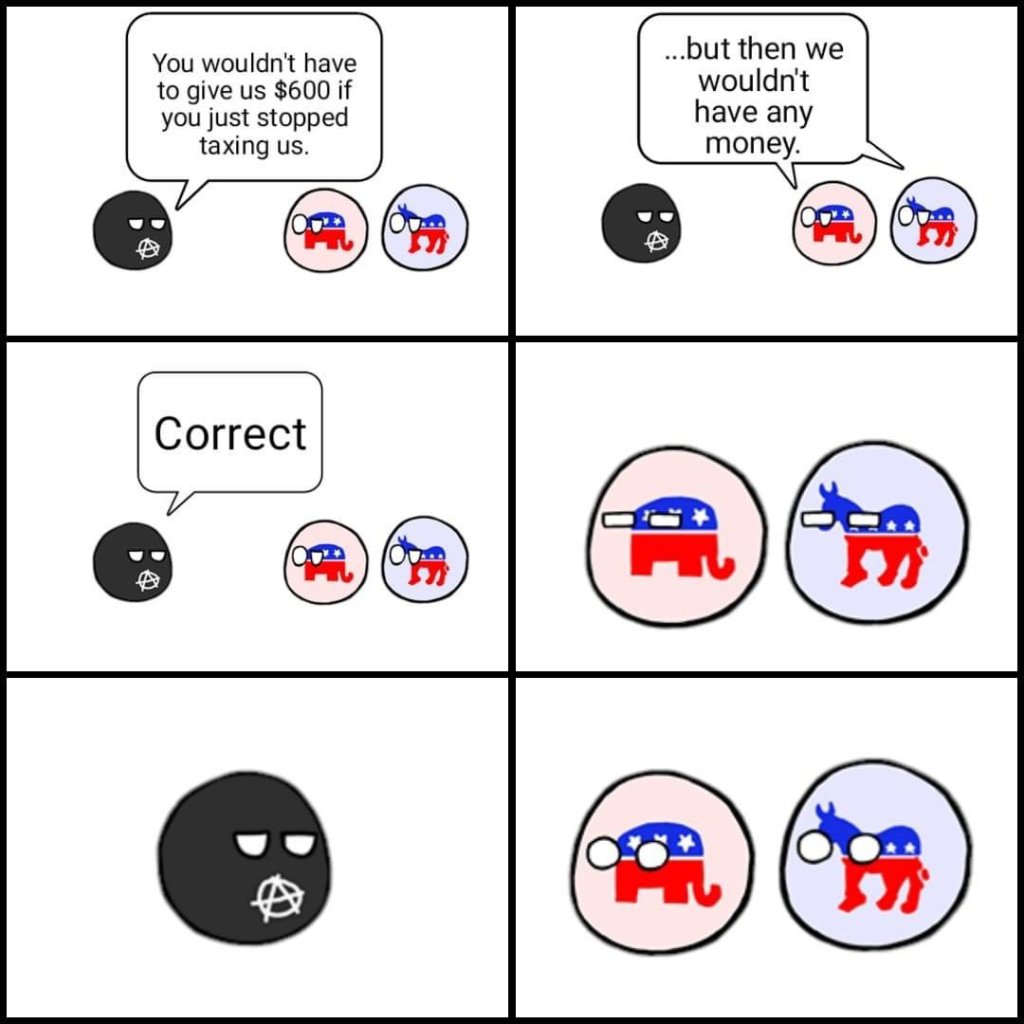
While the US public was forced to grovel for months for a $600 direct payment, the same piece of legislation pumps billions of dollars into “democracy programs” — US government code for regime-change operations via civil society NGOs — and foreign military assistance. The measly $600 survival checks pale in comparison to the massive foreign spending on regime change and titanic allocations to prop up US-friendly authoritarian militaries.
On so-called “Democracy Programs” alone, the legislation appropriates $2.417 billion, and $6.175 billion on the “Foreign Military Financing Program.” Another $112.9 million is appropriated for “International Military Education and Training.”
$6 billion more is allocated toward the domestic procurement of US Air Force missiles and US Navy weapons of war. This is in addition to the $740 billion defense bill passed earlier in December.
By contrast, the stimulus package comes at a value of $900 billion, with the largest portion devoted to business bailouts.
Governors are prohibited from using emergency education funding to give families more education options, thanks to a new provision inserted in the 5,600-page bill that Congress passed (without having time to read it) on Monday night.
The new stimulus package includes $2.75 billion for the Governors Emergency Education Relief (GEER) fund, a program established by the earlier stimulus bill passed in March, but it comes with new restrictions on how that money can be used. Seemingly in response to the fact that several governors used the first round of GEER funding to launch or expand school choice programs, the new stimulus bill explicitly excludes “vouchers, tuition tax credit programs, education savings accounts, scholarship programs, or tuition assistance programs for elementary and secondary education.”
Lawmakers in Congress are under fire from digital rights campaigners for embedding three controversial changes to online copyright and trademark laws into the must-pass $2.3 trillion legislative package—which includes a $1.4 trillion omnibus spending bill and a $900 billion Covid-19 relief bill—that could receive floor votes in the House and Senate as early as Monday evening.
The punitive provisions crammed into the enormous bill (pdf), warned Evan Greer of the digital rights group Fight for the Future, “threaten ordinary Internet users with up to $30,000 in fines for engaging in everyday activity such as downloading an image and re-uploading it… [or] sharing memes.”
While the citizenry had almost no time to process the actual contents of the 5,593 page legislative text, Greer said Monday afternoon that the CASE Act, Felony Streaming Act, and Trademark Modernization Act “are in fact included in the must-pass omnibus spending bill.”
As Mike Masnick explained in a piece at TechDirt on Monday:
The CASE Act will supercharge copyright trolling exactly at a time when we need to fix the law to have less trolling. And the felony streaming bill (which was only just revealed last week with no debate or discussion) includes provisions that are so confusing and vague no one is sure if it makes sites like Twitch into felons.
“The fact that these are getting added to the must-pass government funding bill is just bad government,” Masnick added. “And congressional leadership should hear about this.”
A spending bill, labeled as a relief package for Americans during the Chinese coronavirus crisis, will allow federal bureaucrats to import more foreign workers to take blue-collar jobs in the United States – even as 17.8 million Americans remain jobless.
A provision slipped into the more than 5,590-page spending bill allows the Department of Homeland Security (DHS) and Labor Department to import more foreign labor competition against Americans at their discretion.
Specifically, the bill gives DHS the ability to “increase the total number” of H-2B foreign visa workers who can be brought into the U.S. to take blue-collar, nonagricultural jobs that would otherwise go to working class Americans.
DHS Secretaries over the last four years have repeatedly allowed businesses to import more H-2B foreign visa workers above the annual cap of 66,000. Continuation of the policy would come as 24.5 million Americans are unemployed or underemployed. About 17.8 million of those are jobless.

Congress looks to provide relief to U.S. citizens and small businesses, but the omnibus bill includes some legislative priorities for the entertainment industry as well.
Providing relief via direct assistance and loans to struggling individuals and businesses hit hard by COVID-19 has been a priority for federal lawmakers this past month. But a gigantic spending bill has also become the opportunity to smuggle in some other line items including those of special interest to the entertainment community.
Perhaps most surprising, according to the text of the bill being circulated, illegal streaming for commercial profit could become a felony.
It’s been less than two weeks since Senator Thom Tillis (R-NC) released his proposal to increase the penalties for those who would dare stream unlicensed works. In doing so, the North Carolina Senator flirted with danger. About a decade ago, Minnesota Senator Amy Klobuchar made a similar proposal before it ended up dying as people worried about sending Justin Bieber to jail. (No, seriously.) This time, Tillis’ attempt was winning better reviews for more narrowly tailoring the provisions towards commercial operators rather than users. That said, it’s had very little time to circulate before evidently becoming part of the spending package. If passed, illegal streaming could carry up to 10 years in jail.
That’s not the only copyright change either.
The spending bill also appears to adopt a long-discussed plan to create a small claims adjudication system within the U.S. Copyright Office.
 Hellbound and Down
You must be logged in to post a comment.