Microdosing Magic Mushrooms A ‘Growing Trend’ Among Some Suburban Moms

Magic mushrooms have long been considered a serious drug — the federal government puts it in the same class as heroin — but it’s catching on in the oddest place: suburbia.

Moms in communities around San Diego are “microdosing” mushrooms, which contain the mind-altering substance psilocybin, a new report says.

“It’s so necessary for some of us to be out and forward because we need to move the needle. We need to help give permission to other mothers, to fathers and other families,” said a woman identified only as Mikaela, according to the local CBS affiliate, which published a story headlined “Micro-dosing magic mushrooms: A growing trend among San Diego moms.”

In microdosing, people take a small dose in various forms, which can be pills, gummies, and chocolate. “So a dose that would give you a classic psychedelic effect would be anywhere between a gram to five, six, seven grams and so a microdose is a fraction of a gram,” Mikaela told the station.

Keep reading

How an NHL Enforcer Broke His Body — and Turned to Psychedelics to Heal His Brain

Riley Cote’s journey to enlightenment began in earnest when a hulking man punched him in the face. Cote, now 40 and retired from professional hockey, remembers the moment with a dark laugh. He’d gotten into this particular bust-up one night during the 2009 season with one of the NHL’s most vicious fighters, and took the worst of it, waking the next day with his left eye blackened shut.

“What,” he asked himself, “am I doing?”

He drove to the Philadelphia Flyers training facility and got into the shower. Feeling congested, he reached for a tissue. He didn’t realize he’d suffered a cracked sinus, so what happened next was physics. When he blew his nose, the air — rather than coming out of his nostrils — inflated his face. The pressure surged instantly behind his good eye and closed it tight.

Team trainer Derek Settlemyre heard Cote scream. “His whole face had swollen up,” Settlemyre recalls. “We tell them, if they think they have a fracture, ‘Don’t blow your nose’ — and he did.”

After eight years in pro hockey (four in the NHL, four hopping around its minor-league teams), Cote felt his retirement bearing down. As an NHL “enforcer” — a player whose main role is to get into fights — he’d taken countless hits on the ice. Off it, he self-medicated with booze and drugs. He’d brutalized his body inside and out by the tender age of 28. “I damaged my brain,” Cote says. “Punching it and dehydrating it and partying my ass off.”

Today, Cote is a new man, with a mane of long brown hair, a yoga-trimmed physique, and an aura of ease in his own skin. It is a transformation he credits largely to psychedelic drugs. Since retiring, Cote has emerged as one of the sports world’s most vocal advocates for what he calls “plant medicines” — from cannabis, itself a light psychedelic, to weightier hallucinogens including DMT and magic mushrooms — to treat post-concussion symptoms (think headaches, insomnia, depression, and possibly, the degenerative brain condition known as chronic traumatic encephalopathy, or CTE). In 2017, Cote co-founded Athletes for Care, a group that promotes research into the physical and emotional health issues athletes face and novel paths for treatment. He regularly speaks at conferences on the benefits of psychedelics. And, perhaps most important, he reaches out to players who are known to be struggling post-career, even arranging magic-mushroom ceremonies where they can safely experiment with the drug.

Keep reading

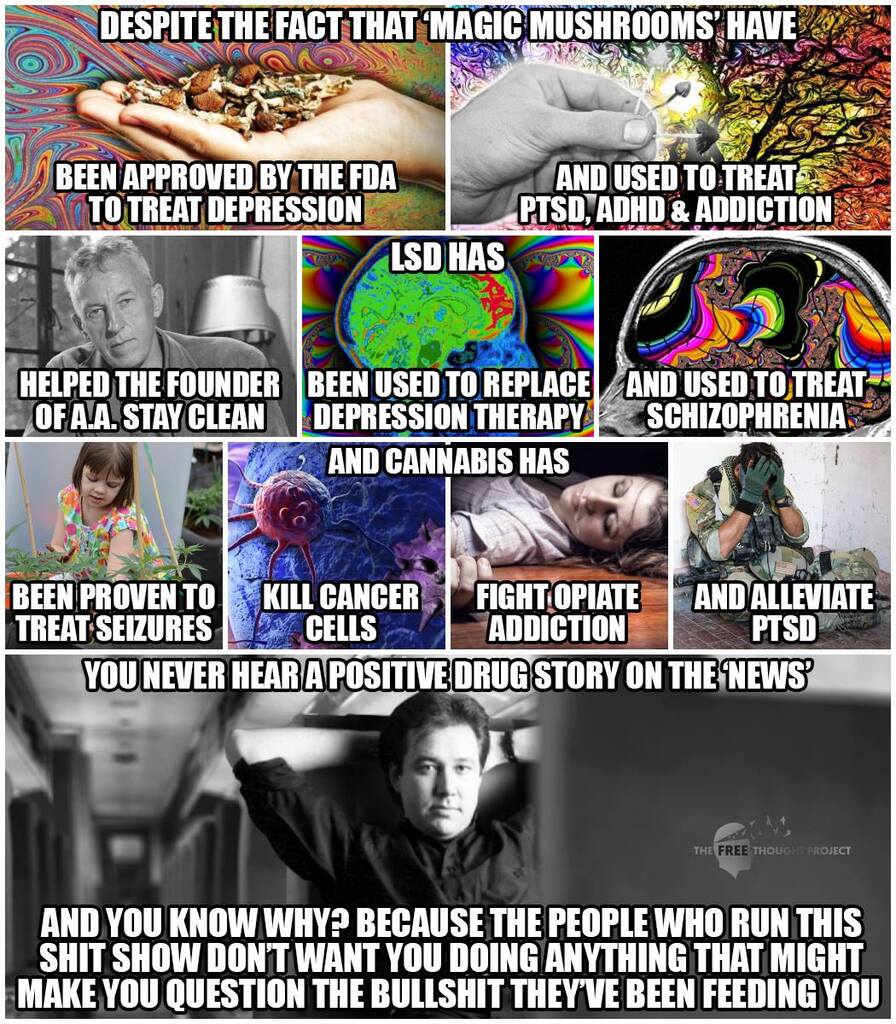
Psychedelics: How They Act On The Brain To Relieve Depression

Up to 30% of people with depression don’t respond to treatment with antidepressants. This may be down to differences in biology between patients and the fact that it often takes a long time to respond to the drugs – with some people giving up after a while. So there is an urgent need to expand the repertoire of drugs available to people with depression.

In recent years, attention has turned to psychedelics such as psilocybin, the active compound in “magic mushrooms”. Despite a number of clinical trials showing that psilocybin can rapidly treat depression, including for cancer-related anxiety and depression, little is known about how psilocybin actually works to relieve depression in the brain.

Now two recent studies, published in The New England Journal of Medicine and Nature Medicine, have shed some light on this mysterious process.

Psilocybin is a hallucinogen that changes the brain’s response to a chemical called serotonin. When broken down by the liver (into “psilocin”), it causes an altered state of consciousness and perception in users.

Previous studies, using functional MRI (fMRI) brain scanning, have shown that psilocybin seems to reduce activity in the medial prefrontal cortex, an area of the brain that helps regulate a number of cognitive functions, including attention, inhibitory control, habits and memory. The compound also decreases connections between this area and the posterior cingulate cortex, an area that may play a role in regulating memory and emotions.

An active connection between these two brain areas is normally a feature of the brain’s “default mode network”. This network is active when we rest and focus internally, perhaps reminiscing about the past, envisioning the future or thinking about ourselves or others. By reducing the activity of the network, psilocybin may well be removing the constraints of the internal “self” – with users reporting an “opened mind” with increased perception of the world around them.

Keep reading

Love & Other Drugs: The Couples Using Psychedelics as a Way To Get Closer

Some couples like to take time off and wander the world to recharge, rejuvenate and reconnect with each other. Others prefer a different kind of trip. 

Psychedelics are increasingly gaining prominence as well as regulatory approval as a form of treatment for mental health disorders ranging from PTSD to anxiety. This has also sparked a larger conversation on whether using hallucinogens like psilocybin mushrooms or LSD could then also emerge as a form of relationship therapy, given that these substances have the ability to curb inhibitions and change the way we perceive reality. 

The rise and rise of psychedelic wellness has also led to couples experimenting with the substances together, either to forge stronger bonds, deal with deep-seated issues in a controlled setting or simply share the euphoric experience together. In fact, though psychedelics are not legal in most countries, relationship counsellors are increasingly advocating their use in counselling sessions, where a couple is administered a mild dosage in a controlled environment, asked leading questions about their hopes and fantasies while they’re tripping, and given calculated counselling based on their experiences. 

“Psilocybin has incredible [potential] as a catalyst for such therapy because it tears down all your walls and filters, and changes the way you think about the relationship,” Kripi Malviya, a psychologist and founder of de-addiction and rehabilitation centre TATVA, told VICE. 

Keep reading

Why Is Everyone Smoking Toad Venom?

In Southampton, soccer moms drop their kids off at school after taking their thrice-weekly microdose of psilocybin mushrooms, then meet for oat milk lattes. In Sun Valley, private retreats dedicated to tripping on MDMA or the Amazonian elixir ayahuasca are becoming almost as common as backyard barbecues. (Just don’t bring the kids.) In Silicon Valley, tech entrepreneurs and financiers turned psychonauts believe that taking small doses of LSD, in either liquid or tab form, helps with creativity and productivity in the workforce. Even rightwing internet investor Peter Thiel has put a formidable stake in Compass Pathways, a publicly traded psychedelic medicine company.

But now there’s a weirder, wilder new drug appearing on the menu for moneyed types in search of mind expansion: the Toad, otherwise known as 5-MeO-DMT (or, if you really want to know its correct name, 5-methoxy-N, N-dimethyltryptamine), or DMT, or Bufo. In his landmark 2018 memoir, How to Change Your Mind, Michael Pollan referred to it as the Everest of psychedelics.

Keep reading

The human brain doubled in power, very suddenly, 200,000 years ago. Why?

There seems to have been a profound difference in cognitive abilities between early Homo sapiens and our immediate predecessor, Homo erectus. Sure, erectus stood upright — a big, um, step forward — but with the emergence of Homo sapiens, we see traces of art, pictography, and tool usage, and we believe humankind made its first forays into language.

In the early 1990s, psychedelic advocate and ethnobotanist Terence McKenna published his book Food of the Gods in which he surmised that homo sapiens’ cognitive leap forward was due to their discovery of magic mushrooms. The scientific community never took McKenna’s theory very seriously, considering it mostly trippy speculation — these days, his ideas have largely been relegated to the spacier corners of Reddit. Now, however, the idea has acquired a new advocate, psilocybin mycologist Paul Stamets, who’s suggesting McKenna was right all along.

In McKenna’s Stoned Ape hypothesis,” he posited that as humans began to migrate to new areas, at some point they came upon psychedelic mushrooms growing in cow droppings, as is their wont, and then ate them. After ingesting them, and more specifically the psilocybin they contained, their brains kicked into overdrive, acquiring new information-processing capabilities, and a mind-blowing expansion of our imaginations in the bargain. Many modern users of psychedelics claim the world never looks the same again after such an experience. As McKenna put it, “Homo sapiens ate our way to a higher consciousness,” and, “It was at this time that religious ritual, calendar making, and natural magic came into their own.”

Keep reading

THE PSYCHEDELIC WORLD OF SEX WORKERS WHO TRIP-SIT THEIR CLIENTS

What happens when you take two heavily criminalized and stigmatized activities and put them together. For many clients — and their sex work providers — it’s nothing short of magic

Ahead of a psychedelic trip, Malakai likes to do a lot of preparation. He curates a playlist to serve as a “rough indication” for how long he’s been tripping. He formulates a custom lighting set-up to avoid disrupting the mise en scène. He cleans the house so his mind won’t wander to the meaningless chores of a mundane reality. 

Basically, when it comes to planning, Malakai doesn’t skimp on the details. But when he asked his regular sex-work provider to trip-sit him, a million more practicalities emerged. “What if I started crying?” Malakai, a pseudonym, recalls asking himself. “Would I fall in love with her? Would she get bored while I become detached from reality?” As it turns out, he needn’t have worried. “Rachel [also a pseudonym] saw no barriers to my concerns and seemed determined to turn my fantasy into a reality,” Malakai tells me. 

A trip-sitter is a common phenomenon among psychedelic drug users, and it’s just a person who babysits you while you trip (most routinely with magic mushrooms, acid or DMT). The practice is credited as a form of harm reduction, offering those on the trip a sense of safety, and hopefully, a peace of mind for a more positive trip (though experts are quick to warn that this isn’t guaranteed). Typically, you might ask a friend or family member to trip-sit, or even hire a professional trip-sitter. Or you might knock on the door of your regular sex-work provider.

Keep reading

How COVID-19 Opened the Door to a New Era in Psychedelic Medicine

From Wall Street to Hollywood, psychedelics are having a cultural moment. For those of us who grew up in the “this is your brain on drugs” era, it’s hard to let go of stigma—and the mental image of an egg sizzling on a hot pan. But as a growing number of states and cities move to decriminalize drugs, and investors flock to an emerging market for psychedelic health care, substances like psilocybin, ketamine and LSD are edging into mainstream culture—and setting the stage for a paradigm shift in modern medicine.

Within the next few years, we could see psychedelic therapies prescribed for refractory depression and post-traumatic stress disorder (PTSD), or used in palliative care among those facing a life-limiting illness. But first we need to more deeply understand the benefits of psychedelic treatments. Right now, we are in the perfect storm to accelerate continued study—and health care workers are on the front lines.

It’s no coincidence that psychedelics are entering the conversation at the moment we most sorely need new ideas in mental health care. The world is experiencing mass trauma from COVID-19. It’ll take years for us to truly understand the magnitude of the pandemic’s toll on our collective mental health, but on the front lines, the picture is much clearer. In a recent survey of more than 20,000 frontline medical workers, 38% reported experiencing anxiety or depression during the pandemic, and 49% suffered burnout. Another survey found nearly one-quarter of all health care workers showed signs of probable PTSD.

When the American Association of Critical-Care Nurses surveyed 6,000 of their members this year, 66% said they had considered leaving their jobs because of the pandemic. “No amount of money could convince me to stay on as a bedside ICU nurse right now,” a Seattle-area nurse wrote in a resignation note posted on Twitter. “I can’t continue to live with the toll on my body and mind. Even weekly therapy has not been enough to dilute the horrors I carry with me from this past year and a half.”

Among health care workers, the prolonged battle against COVID-19 has intensified a long smoldering problem. Facing a fragmented medical sytem with frequently misaligned incentives, health care workers have been grappling with anxiety and depression—even before COVID, the suicide rate among doctors was more than twice that of the general public. From support groups and training to apps that monitor mental health, there are a number of programs that aim to solve and treat the problems leading to clinician burnout. But most have barely scratched the surface, and the prevalence of burnout during the pandemic has led researchers to explore alternative solutions—including psychedelic therapies.

A new study at the University of Washington is evaluating the efficacy of psychedelic-assisted psychotherapy using psilocybin for frontline health care workers experiencing COVID-related distress. “The situations that frontline doctors and nurses are facing is unprecedented,” says Dr. Anthony Back, who’s leading the study. “The symptoms of depression, burnout and moral injury call out for research that looks at whether psychedelics can play a role in healing the healers.” The U.S. is not alone in seeking alternative therapies for the growing number of health care workers in crisis: at Vancouver Island University in Canada, the Roots to Thrive ketamine-assisted therapy program treats health care providers and first responders with PTSD, depression, anxiety and addiction.

Keep reading