
Where do you think it is coming from?


In June of this year, a police officer with over two decades on the job was found dead in the Winnemucca Police Department’s evidence locker. He had a bag of fentanyl in his pocket, yet when his death was announced, it was reported that officer Matt Morgan died of “natural causes.” The very next day, dozens of police departments from around the area put together a procession parade two hours long in his honor as people stood along the route to pay their respects. But Morgan didn’t die of natural causes and he had no business being in the department’s evidence locker that day.
“A procession honored Winnemucca Police Department Detective and community hero Matt Morgan, 47, who passed away unexpectedly while at work on Thursday, June 25, 2020, of apparent natural causes,” the report read after Morgan passed away.
But his death was not natural. Weeks later, an investigation would reveal that Morgan overdosed on fentanyl and methamphetamine in that evidence locker. What’s more, Morgan was not supposed to be in the locker that day and the investigation revealed that the evidence (seized drugs) had been tampered with by this “hero cop.”
According to the Humboldt County Sheriff’s Office, who is conducting the investigation, it is still ongoing.
Police officers in Texas were told some terrifying news on June 26, 2018: Anti-government flyers poisoned with a deadly opioid had been placed on Harris County Sheriff’s Office squad cars, and a sergeant who had touched one was en route to the hospital with overdose symptoms. The incident set off a flurry of media coverage, and it frightened police halfway across the country. The Maine Information Analysis Center forwarded Harris County’s bulletin to local departments, while the Commonwealth Fusion Center wrote its own safety alert for Massachusetts officers.
But it wasn’t true. Three days later, a laboratory analysis found that there was no fentanyl on the flyers. The Harris County Sheriff’s Office blamed the panic on a problem with field test kits.
Fentanyl, a synthetic opioid hundreds of times more powerful than morphine, is responsible for about half of overdose deaths in the United States. Among law enforcement, it has taken on mythical properties. First responders around the country have claimed to have nearly died from accidental exposure, based on the scientifically inaccurate idea that a deadly amount of fentanyl can pass through human skin or even poison the air around it.
That myth has spread through a surprising avenue: America’s counterterrorism agencies.
Leaked police documents reviewed by Reason show that fusion centers—local liaison offices set up by the Department of Homeland Security in the wake of 9/11—have circulated fentanyl myths, causing police officers to panic and wasting first responders’ time.
The documents were first released as part of BlueLeaks, a massive trove of law enforcement data leaked by the hacker collective Anonymous. Out of 121 fentanyl-related bulletins in the BlueLeaks trove reviewed by Reason, at least 36 claimed that fentanyl could be absorbed through the skin and at least 41 discussed the alleged danger of airborne fentanyl.
FBI officials even claimed that fentanyl is “very likely a viable option” for a chemical terrorist attack in a September 2018 bulletin, although they also admitted that there is “no known credible threat reporting” suggesting that anyone was actually planning such an attack.
The more the myths spread, the more officers in the field panicked, convinced that they had fallen victim to an accidental fentanyl overdose.
Fentanyl is a genuinely dangerous drug. A state trooper in Salem County, New Jersey, fainted and had to be revived with naloxone in September 2018 during a drug bust, according to a bulletin by the New Jersey Regional Operations and Intelligence Center. The officer had touched their face with fentanyl-contaminated hands—likely bringing the drug into contact with the mouth or eyes—and later tested positive for opioid exposure.
But overdosing “from transdermal and airborne exposure to Illicitly Manufactured Fentanyl (IMF) is a near scientific impossibility,” according to the Harm Reduction Coalition.
In other words, fentanyl can’t jump through air or the skin to suddenly kill you.
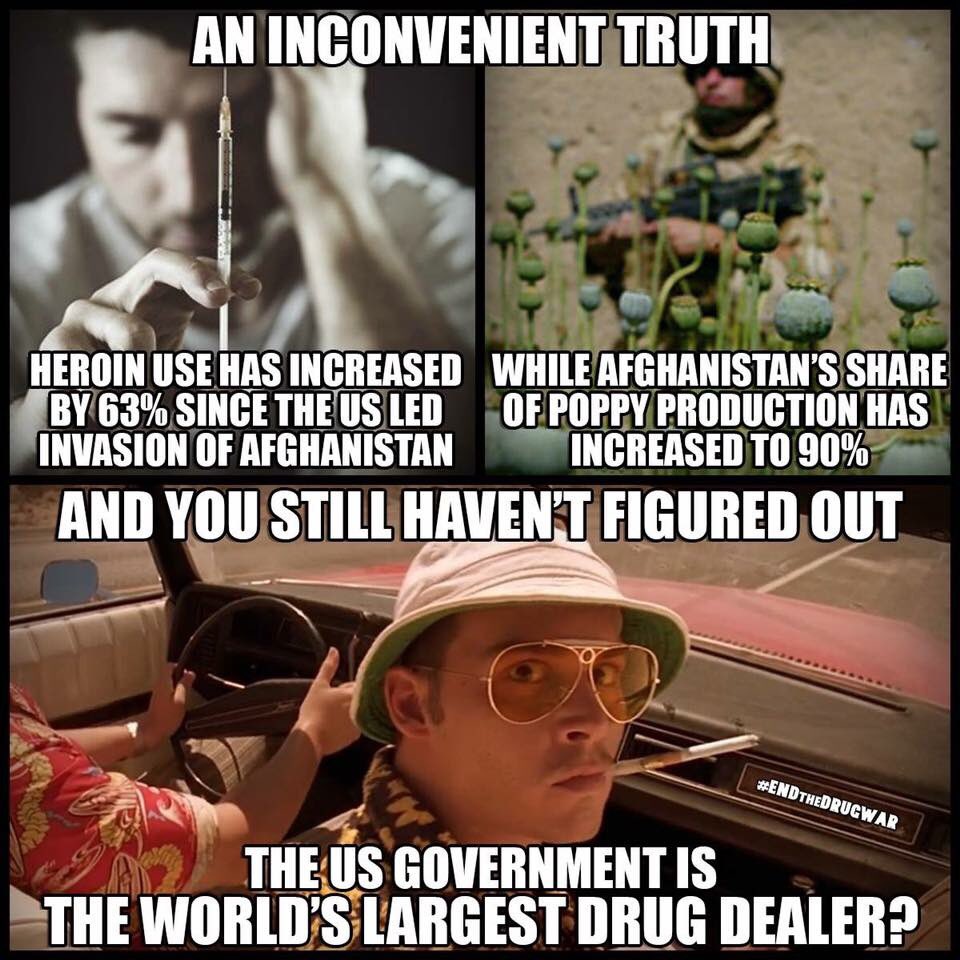
Heroin production in Afghanistan increased 40 times since NATO began its ‘War on Terror’ in 2001, the head of Russia’s Federal Drug Control Service stated, adding that more than 1million people have died from Afghan heroin since then.
“Afghan heroin has killed more than 1 million people worldwide since the ‘Operation Enduring Freedom’ began and over a trillion dollars has been invested into transnational organized crime from drug sales,” Viktor Ivanov said at the conference on the drug situation in Afghanistan.
Ivanov stressed that the main factor of instability in the war-torn country remains the prosperous heroin industry.
“Any impartial observer must admit the sad fact that the international community has failed to curb heroin production in Afghanistan since the start of NATO’s operation.”
According to his presentation at UN’s 56th session of the Commission on Narcotic Drugs in Vienna on March 11, opium growth has increased by 18 per cent from 131,000 hectares to 154,000.
As the situation in Afghanistan changed with NATO withdrawing its troops, Russia along with Afghanistan and the international community must face the new reality and develop an efficient strategy to deal with the heroin problem, explained Ivanov.
Opium production has been central to Afghanistan’s economy ever since US and NATO forces invaded in October 2001. Just before the invasion Taliban had implemented a ban on poppy growing, declaring it to be anti-Islam, which lowered the overall production. But after the West’s involvement, production resumed and now the country produces some 90 per cent of the world’s opium, the great bulk of which ends up on the streets of Europe and Russia.
Americans are struggling to cope with the coronavirus pandemic after months of harsh lockdowns, widespread disease and economic suffering that has fallen disproportionately on the young, minorities and those who are most vulnerable to financial shocks.
A new study from the Centers for Disease Control and Prevention (CDC) finds the number of Americans reporting adverse mental health or behavioral changes — like drinking or drug use — on a perilous rise in recent months.
About a quarter of Americans reported symptoms of an anxiety disorder, three times higher than what a similar survey found a year ago. Those reporting depression has quadrupled, to nearly a quarter.
About 13 percent of Americans said they were drinking or using drugs more because of the stress of the pandemic. And almost 11 percent said they had seriously considered suicide in the last month, including more than a quarter of those between 18 and 24 years old.

Center for Disease Control Director Robert Redfield testified in a Buck Institute webinar that suicides and drug overdoses have surpassed the death rate for COVID-19. Redfield argued that lockdowns and lack of public schooling constituted a disproportionally negative impact on young peoples’ mental health.
“We’re seeing, sadly, far greater suicides now than we are deaths from COVID. We’re seeing far greater deaths from drug overdose that are above excess that we had as background than we are seeing the deaths from COVID,” he said.
Roughly 146,000 people have died from COVID or COVID-related causes in the U.S., according to CDC data.
The most recent publicized federal data records 48,000 deaths from suicide and at least 1.4 million attempts in 2018. In 2019, almost 71,000 people died from drug overdoses.
Where Redfield obtained his data is unknown, although a doctor at John Muir Medical Center in Walnut Creek, CA claimed the facility has “seen a year’s worth of suicide attempts in the last four weeks.” He did not say how many deaths occurred, or whether the statement was exaggerated for emphasis.

 Hellbound and Down
You must be logged in to post a comment.