
Big Tech, Pharma, Finance Urge SCOTUS to Uphold Race-Based Discrimination in College Admissions

A large cross-section of corporate America filed briefs with the Supreme Court on Aug. 1 urging the court to allow colleges to continue using race as a factor in student admissions.

The court is poised to hear challenges to these racially discriminatory policies in its new term that begins in October. The challengers say so-called affirmative action not only hurts white applicants, but works out to be an “anti-Asian penalty” as well. Asian American applicants generally have higher academic scores and higher extracurricular scores, they say.

Some legal observers speculate that the nine-member court—whose six-member conservative majority broke new ground in June by curbing environmental regulatory powers, declaring that the court was wrong to recognize a constitutional right to abortion 49 years ago, and declaring that there is a constitutional right to carry firearms in public for self-defense—wouldn’t have agreed to hear challenges to race-based college admissions unless it intended to curb them.

The use of race-based criteria by institutions of higher learning in the admissions process isn’t popular in the United States.

Surveys from both Pew Research Center and Gallup have indicated that nearly 75 percent of Americans of all races “do not believe race or ethnicity should be a factor in college admissions.”
Keep reading

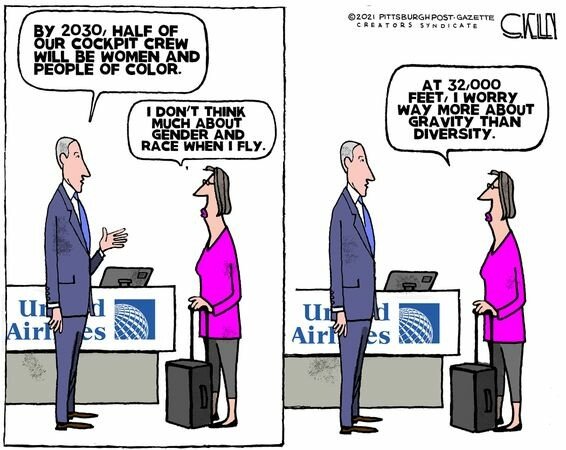
United Airlines prepares to shake up white, male-dominated pilot population

United Airlines said on Tuesday it wants women and people of color to make up at least half of the 5,000 pilots it plans to train this decade at its new flight school, a push to diversify a career traditionally dominated by white men.

The announcement comes as U.S. airlines resume pilot hiring halted last year during the pandemic and as they find themselves in the crosshairs of politically charged issues involving race.

“We want to make sure that we are tapping into a big deep talent pool and not limiting ourselves to just one section of the pond,” Chief Communications Officer Josh Earnest said on a Zoom call with journalists.

Chicago-based United joined Delta Air Lines and American Airlines on Monday in speaking out against voting restrictions following recent legislation in states like Georgia that activist groups say unfairly target Black and other racial minority voters.

Keep reading

End the ‘Systemic Racism’ of Affirmative Action

As the nation’s incipient racial reckoning following last May’s killing of George Floyd morphed into the summer’s riotous anarchy, the term “systemic racism” emerged as a fixture of our public discourse. What began as a somewhat arcane dialogue about purported police “militarization” and the “qualified immunity” legal doctrine soon took on a much more insidious tone. America, those like the New York Times‘ “1619 Project” fabulists told us, was rotten to its very core, blemished by the indelible taint of “systemic racism.”

In reality, as many courageously pointed out amid unprecedented “cancel culture” headwinds seeking to stifle all dissent, there is no such thing as “systemic racism” that afflicts all of America’s leading institutions. Despite the claim attaining mythological status, there is no factual basis to support it. There will, sadly, always be individual racists from all backgrounds and all walks of life, but American society in the 2020s simply does not have anything remotely resembling a legally enshrined regime under which its racial majority “systemically” oppresses its racial minorities. America in the year 2021 is not Germany in 1936; it is not South Africa in 1985; it is not—after the Civil Rights Act of 1964 and the Voting Rights Act of 1965—the Jim Crow South. This ought to be astoundingly obvious.

Keep reading