Ohio Guard shootings at Kent State 55 years ago fueled protests at Ohio State, across U.S.

On this date 55 years ago, May 4, 1970, Ohio National Guard members fired on student protesters at Kent State University, killing four students and wounding nine others.

The students were protesting the escalation of the Vietnam War into Cambodia. The shootings became a pivotal moment in the anti-Vietnam War movement, highlighting the deep divisions and tensions in the country at the time over U.S. involvement and the loss of lives.

An investigation was conducted into the Kent State shootings by the Ohio National Guard, who were sent to the university and nearby town by Ohio Gov. James Rhodes at the request of town officials in response to violence May 1, 1970, in which downtown businesses were damaged.

Eight guardsmen were later indicted by a federal grand jury for their involvement in the May 4 shootings. But U.S. District Court Judge Frank Battisti dismissed the case in the middle of the trial, claiming the government’s case was so weak the attorneys for the guardsmen didn’t even have to present a defense.

Students at Ohio State, along with many other universities across the country, were deeply affected by the shootings at Kent State and the broader issues surrounding the Vietnam War. Protests at Ohio State intensified immediately after the Kent State shootings, leading to clashes between students and authorities there. The campus saw large demonstrations, sit-ins, and strikes as students expressed their outrage and demanded changes.

These protests were part of a nationwide wave of student activism that sought to address not only the Vietnam War but also issues of civil rights and social justice.

Several days before Kent State, on April 29, 1970, Ohio State students boycotted classes after administrators rejected calls to add Black and women’s studies courses to the university curriculum. Columbus Mayor M.E. “Jack” Sensenbrenner declared a state of emergency and a curfew was put in place on April 30, 1970

Keep reading

The May 4th Deaths: Kent State 54 Years Ago

On May 4, 1970, Ohio National Guardsmen killed four college students and wounded nine others – one of them, Dean Kahler, is paralyzed below the waist – on the campus of Kent State University. Nobody was found guilty of the bloodletting.

On that awful day, Guardsmen fired M-1 rifles, .45 pistols and a shotgun for 13 seconds, killing Allison Krause and Jeffrey Miller, ROTC student William Schroeder and Sandra Scheuer who was on her way to class, while wounding nine others. Many Americans were outraged at the shootings but the vast majority were not, apparently believing that a nation at war was threatened by “radical” challenges on college campuses and elsewhere and that a government at war was perfectly justified in spying on its dissenting citizens and sending provocateurs to disrupt antiwar opponents. (On May 14-15, 1970, in Jackson, MS., Phillip Gibbs, a Jackson State junior, and James Green, a bystander and high school student, were killed by officers called to the scene following disturbances and student protests against the Vietnam war and continuing bias against blacks. A dozen students were also wounded by gunfire. Again, no one was ever convicted. (See, for example, Tim Spofford’s Lynch Street: The May 1970 Slayings at Jackson State College Kent State University Press).

Antiwar protests in Kent erupted following Richard Nixon’s TV speech announcing on April 30 that the US had invaded Cambodia, thus expanding a war he had once pledged to bring to an end. The following day Nixon denigrated antiwar students as “bums.”

Keep reading

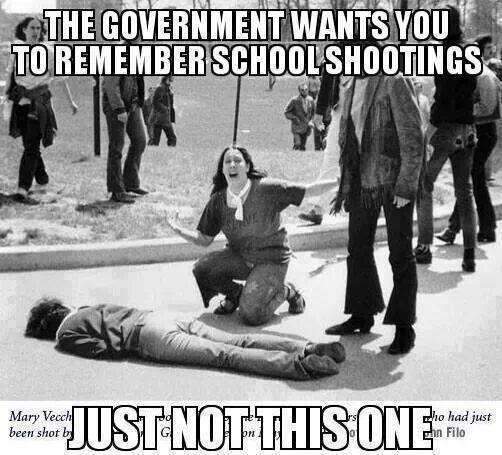
It’s the Anniversary of the One School Shooting the Govt Won’t be Ramming Down Your Throat

On May 4, 1970, a disorganized and nonviolent antiwar protest turned violent and deadly when the Ohio National Guard inexplicably opened fire on students at Kent State University — indelibly polarizing the United States populace to an extreme arguably unabated since.

Guardsmen opened fire on the assembled crowd, unleashing between 61 and 67 bullets in 13 seconds — which left four people dead and nine wounded. Now, 49 years after the unjustified bloodbath, critical questions remain unanswered about both details of the incident, as well as circumstances that culminated in the shooting of unarmed protesters.

Perhaps the only inarguable detail of the Kent State massacre, often referred to simply as “Kent State,” is the fundamental, polarizing shift in popular perception.

Keep reading